New York Central Alcos

New York Central Alcos
NYC RS32 #2040 leads a trio of R32s hauling Train NY-4

Sunday, January 18, 2026

The New York Central System In Transition Part 2

Greetings All, 

Welcome back to the New York Central System in Transition
Today we'll take a look at how the NYC positioned itself to take advantage of infrastructure upgrades, track upgrades and the addition of new rolling stock in an attempt to become profitable.
Forward Thinking at a Critical Time
President Perlman addressed the need for cost cutting, improved infrastructure, efficient operations, and reducing labor costs by using both innovative and draconian measures like laying off ten thousand employees to save the railroad.

During this era the New York Central developed a network of super yards across the system. Here is a look at some of them.
Selkirk Yard
Selkirk Yard was modernized in the mid 1960s as a large computerized push button hump facility and dedicated as Alfred E. Perlman Yard. In 1966 it had a capacity of 5,195 cars.
"File: South Bend NYC Aug 1962 2-20.jpg" by Lawrence and David Barera is licensed under CC BY-SA 2.0.
DeWitt Yard
Dewitt Yard east of Syracuse was among the oldest hump yards on the Central. The west bound hump had a 4,980 car capacity. The eastbound hump held 5,855 cars. In the diesel era DeWitt was the primary diesel shop and base for most Alco and GE locomotives. 
Frontier Yard
In 1956 the railroad built Frontier Yard east of downtown Buffalo. As the Central's first large electronically controlled hump yard Frontier was designed to supplant eight older facilities. Despite Frontier's 5,140 car capacity several fair sized flat switching yards were still needed to serve local industries.
"Conrail 7587 1002 and 9557 Frontier Yard Buffalo May 1991" by Mark Fischer is licensed under CC BY-SA 2.0.
Niagara Falls
A large flat yard accommodated chemical and interchange traffic moving thru the Niagara Gateway.
"Niagara Falls NY train yard" by spinneyhead is licensed under CC BY-NC-SA 2.0.
Pittsburgh & Youngstown
NYC affiliate Pittsburgh & Lake Erie operated a large yard at McKees Rocks near Pittsburgh. 
"Pittsburgh and Lake Erie Railroad Company McKees Rocks yards and shops, with two roundhouses 1946" by over 26 MILLION views Thanks is licensed under CC BY-NC-SA 2.0.
In 1958 the railroad opened Gateway Yard at Youngstown, Ohio replacing several smaller yards. Gateway was an immense facility covering roughly 200 acres and five miles long. Gateways 35 track hump classification had a capacity for 1,697 cars while its 21 track receiving yard had a 3,076 car capacity. Gateway could process up to 2,700 cars per day.
"3/20/79, trackage in Youngstown, OH." by OHFalcon72 is licensed under CC BY-NC-ND 2.0.
Collinwood Yard
The railroad's primary Cleveland area facility was Collinwood Yard which featured a large flat switching yard and the primary shops for the railroad's EMD diesel fleet.
"4/7/78, CR GP40 3261" by OHFalcon72 is licensed under CC BY-NC-ND 2.0.
Elkhart Yard
In the modern era NYC built two large  computer controlled hump yards in Indiana, one on the Chicago mainline at Elkhart and the other on the Big Four at Indianapolis. Elkhart was built on the site of an older yard in 1957 and dedicated to Robert R. Young. Elkhart featured a modern electronic hump with 72 classification tracks and could hold nearly 7,000 cars. It primarily handled traffic moving via the Chicago gateway and classified interchange traffic to many Chicago area railroads making it one of the Central's busiest yards in the 1960s.
"UP staring us down on the west end of the yard" by Shakes1420 is licensed under CC BY-SA 2.0.
Avon Yard
Serving Indiana's largest city Avon Yard also known as Big Four Yard was built in 1960 as a modern hump facility. It featured 53 classification tracks, a 7 track departure yard and a 9 track receiving yard. Avon's primary function was to classify traffic moving to and from the St. Louis gateway.
"Avon Yard on a cloudy day from the east" by JarrahTree is licensed under CC BY 2.5.

CTC and Other 1957 Improvements
Traffic, Hump Yard and Flexi-Van Service.
New York Central Fast Freight
Traditional American rail freight operations were notoriously slow. Before the advent of motorized trucking and paved roads even glacially slow freight was faster than the alternatives. By the 1920s trucks using improved highway transportation began to cut into the traditional Less Than Carload (LCL) business where it was better suited for door to operation.
Pacemaker Service
In an effort to keep ahold of the LCL business the NYC emphasized the Pacemaker as a fast express service that featured free pick up and delivery using NYC trucks. In the early years of service the Pacemakers were assigned Mohawk and Niagara steam locomotives west of the electrified lines as seen below.
Typical Pacemaker trains would depart Manhattan with 25 cars and make pick ups along the way to Buffalo handling some 50-75 cars. These priority trains were among the first to regularly receive diesel power like the below Erie Built.
Early Bird Service
Pacemaker service survived into the mid 1950s but was deemphasized following the 1954 introduction of the Early Bird Service trains that concentrated recapturing carload traffic through improved scheduling. New York - Chicago service was promised in 29 hours. A cartoon bird with an engineer's cap and pocket watch was featured in advertising the "on time a day early" slogan.
Flexi-Van Service
The Early Bird service was relatively short lived as the New York Central started promoting its Flex-Van trains that consisted of two 40' vans riding on a spine car. The NYC purchased over 7,000 vans and 859 Flex-Van flatcars equipping the railroad to run 50 daily high speed Flexi-Van trains called Super Vans.
The Flexi-Van trains were very profitable for the NYC. Unfortunately few other roads embraced the technology (Milwaukee Road and Illinois Central were two exceptions) and the Flexi-Vans became a largely NYC only captive phenomenon.
With the need to interchange this traffic and ensure an availability of such equipment in 1964 the Central bought into the Trailer Train consortium.
The Road to the Future
Starting in June,1959 NYC boxcars began to receive the cigar band style herald (also known as the road to the future herald) that was approved earlier in the year by the Board of Directors. The cars were painted Century Green with black ends and roofs. In 1963 the cars started getting full Century Green paint and smaller heralds.
Cigar Bands replace Lightning Stripes
Around the same time to save money when the locomotives are shopped and repainted the dashing Lightning Stripe paint scheme is replaced by the austere Cigar Band scheme featuring the road to the future heralds.
"Two New York Central E8As at Hudson, NY" by railfan 44 is marked with Public Domain Mark 1.0.
Recovering, Maintaining and Expanding the Customer Base
The Automotive Industry
While the automobiles on the interstates eroded the passenger car loadings the Central profited greatly by supplying equipment and motive power to haul the products needed to manufacture and ship  finished automobiles. 

Boxcars dedicated to automotive service started to appear in 60' and later huge 86' Hi Cube boxcars featuring four or eight doors as specified by the auto manufacturer. NYC 53051, a PCCM regular, was part of an 85 car order (53000-53084) delivered in 1963 by GSC under lot #932-B
Below are two 60' boxcars that were part of an 81car order (56451-56531) built by built by Pullman Standard in 1966 under lot #985B assigned to the Monroe, MI pool as noted by the small writing to the left of the door.
A pair of lot 987-B 60' double door boxcars built by Pullman-Standard in 1966. Of the 110 cars (53860-53969) in this lot 87 were assigned to Ford Bumpers in Monroe, and 19 cars to Ford Bumpers in Ypsilanti. The below cars are also assigned to the Monroe Pool.
NYC 67086 is the 8 door version of the 86' boxcars favored by General Motors and Chrysler. This car was part of a 57 car order  (67040-67096) built by Pullman Standard in 1965 under lot #949-B. The cars in this group were assigned to Chevrolet. The below car is assigned to the Parma, Ohio pool.
NYC 67022 is the 4 door version of the 86' boxcars assigned to the Ford Motor Company. The 67022 is part of a 40 car order (67000-67039) built by Greenville in 1964 under lot #940-B. This group was assigned to the Ford Motor Company.
Auto Racks Revive Automobile Shipping
Replacing the cumbersome 50' boxcars that could hold four automobiles with tri level auto racks that could hold fi
fteen cars and bi level auto racks that could hold 10 cars or light trucks brought this profitable traffic back to the rails.

NYC 64413 was part of a 500 car order (64000-64499) built by Despatch Shops Inc. in Rochester, NY in 1941 under lot #701-B.
The New York Central rostered many of the 89' bi level and tri level auto racks built by Pullman Standard (MDAX and KTTX reporting marks) and American Car & Foundry (NIFX and MDX reporting marks) starting in 1961.
Other Innovations
Evans Breadbox Trough Coil Coaches
P&LE 42278 and 42279 were part of  50 car order (42250-42299) built by Evans in 1967 under lot #111-F. The cars were designed so a single person could open and close the coil covers. The covers however proved to be troublesome from wear and tear and rough handling and were later removed.
55' Coil Steel Flatcar
NYC 752034 was part of a 100 car order (752000-752099) built by Evans in 1965 under lot #984-F. These cars had the more traditional angled coil covers installed and removed by cranes.
The Stretch Program
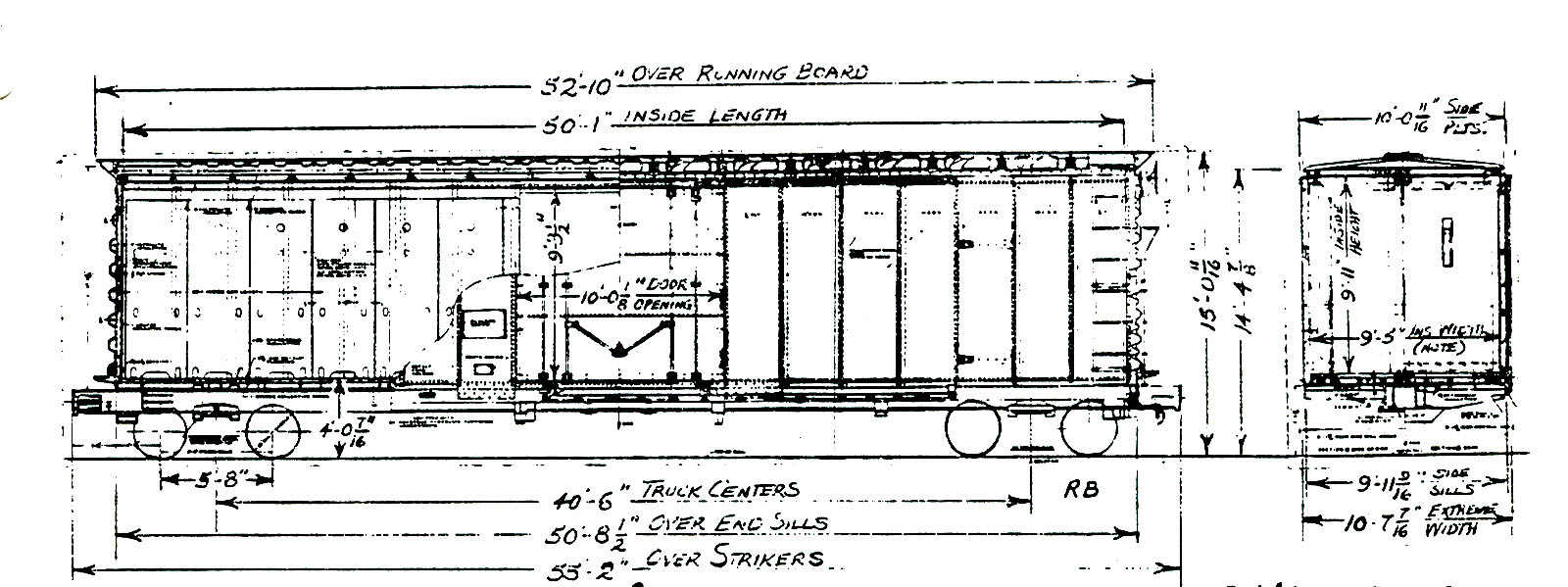
In 1966 with the need for larger boxcars New York Central's Beech Grove Shops rebuilt and stretched 800 40' boxcars into 50' boxcars under lot #992-B The stretched cars carried road numbers 150000-15799.
Other Specialty Freight Cars
NYMX Mechanical Refrigerators
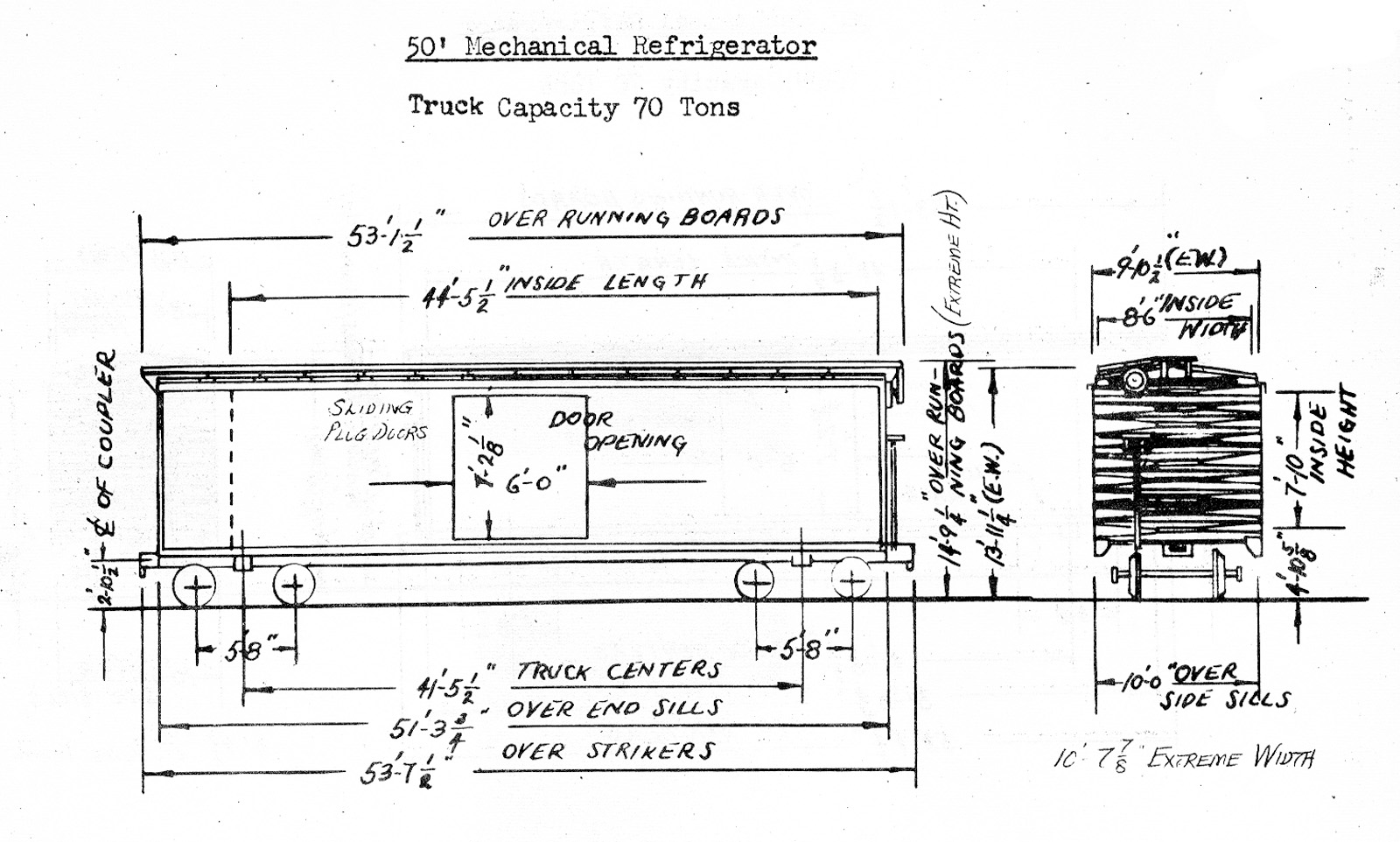
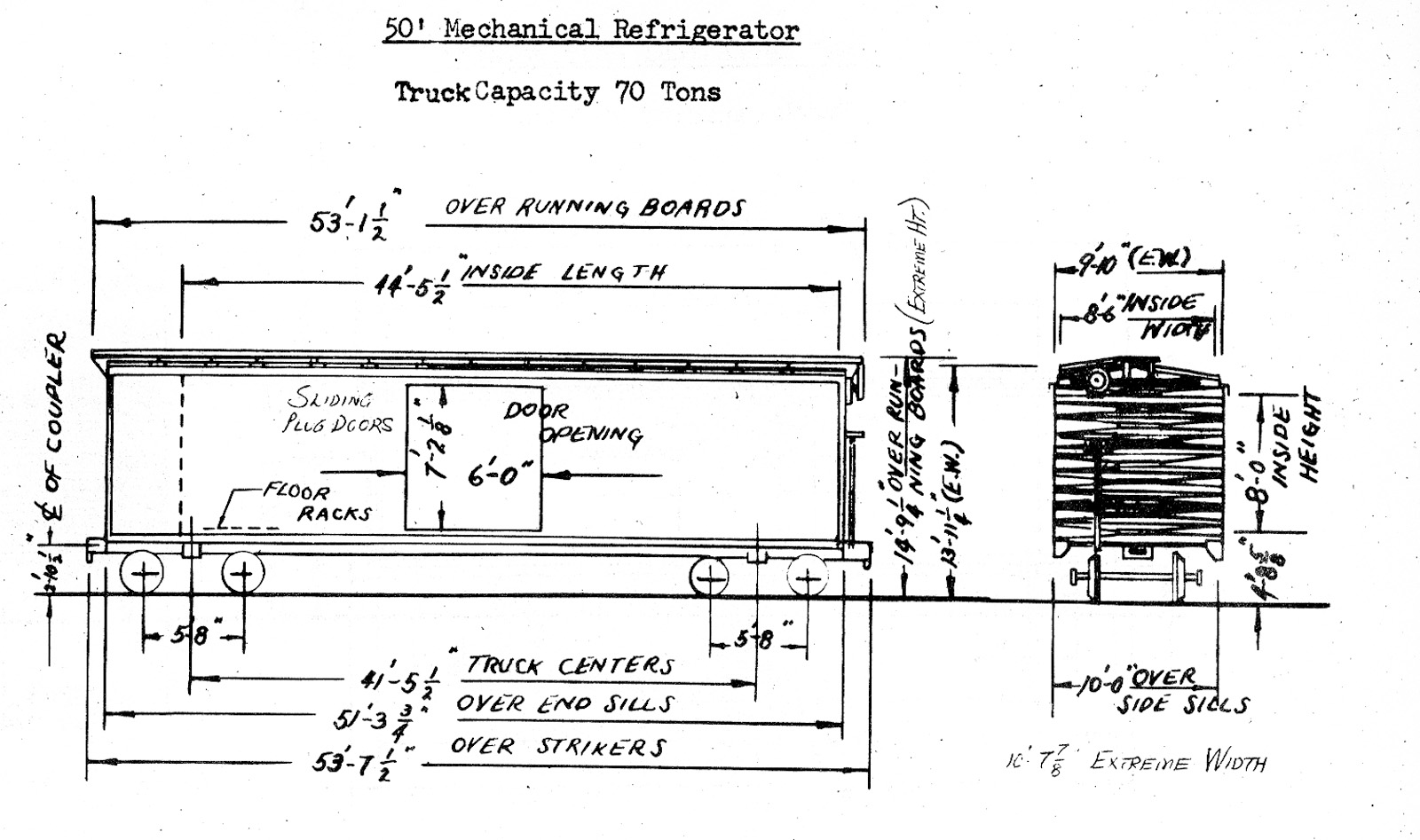
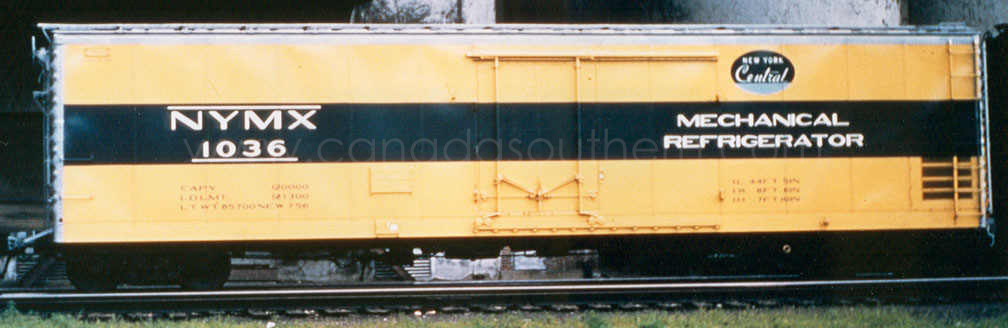
The NYC purchased 50 mechanical refrigerators built by Pacific Coast & Foundry in 1956 under lot #562 and 562A. The cars were numbered 1000-1049.
NYRX Bunker Less Refrigerator Cars
The NYC also added 100 RBL reefers built by Despatch Shops Inc. in 1958 under lot #936 with NYRX reporting marks and an Early Bird Logo on the sides. The cars were all steel numbered 2500-2599 and looked a bit like this wood side MDT reefer.
Flexi-Flo Covered Hoppers
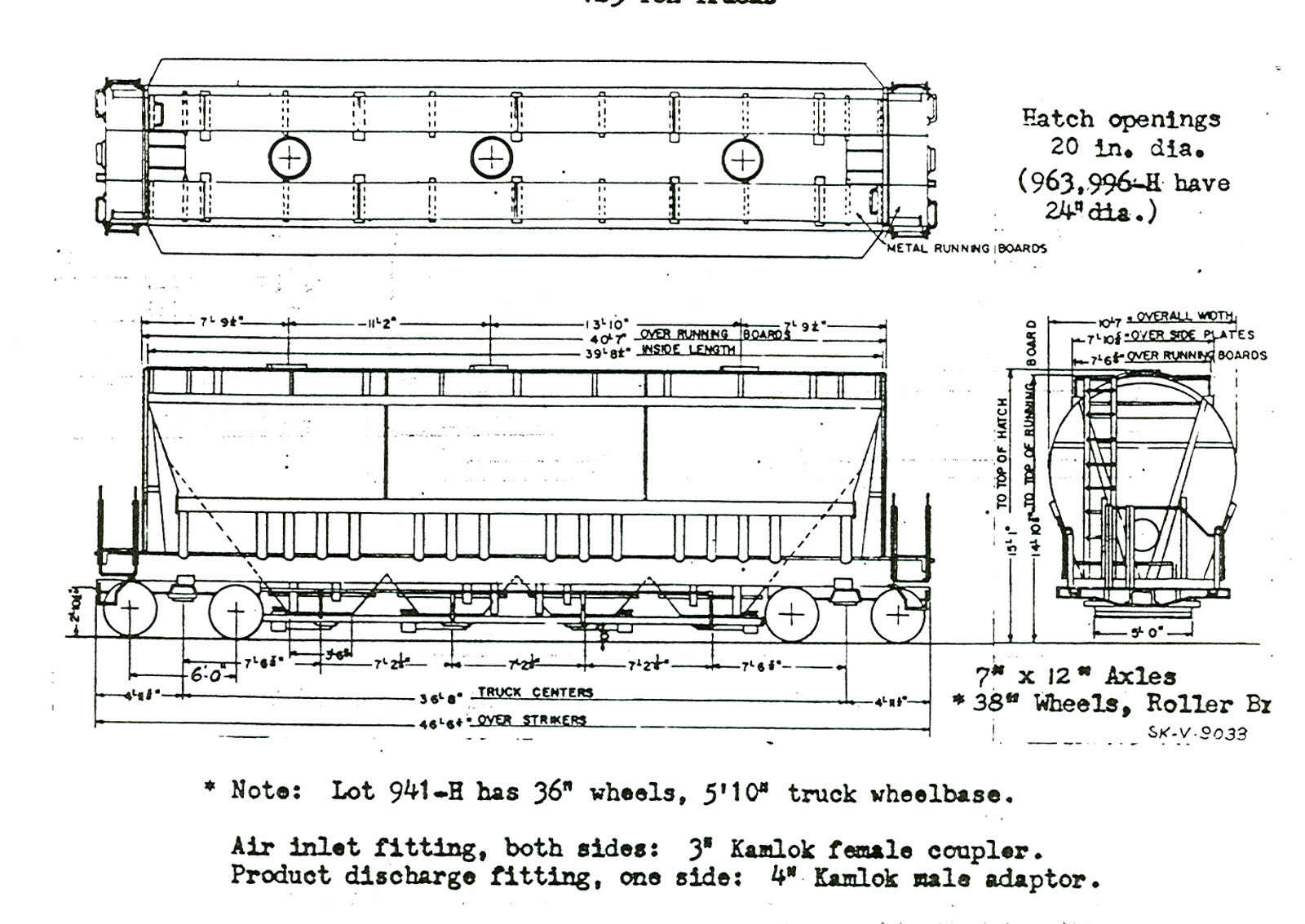
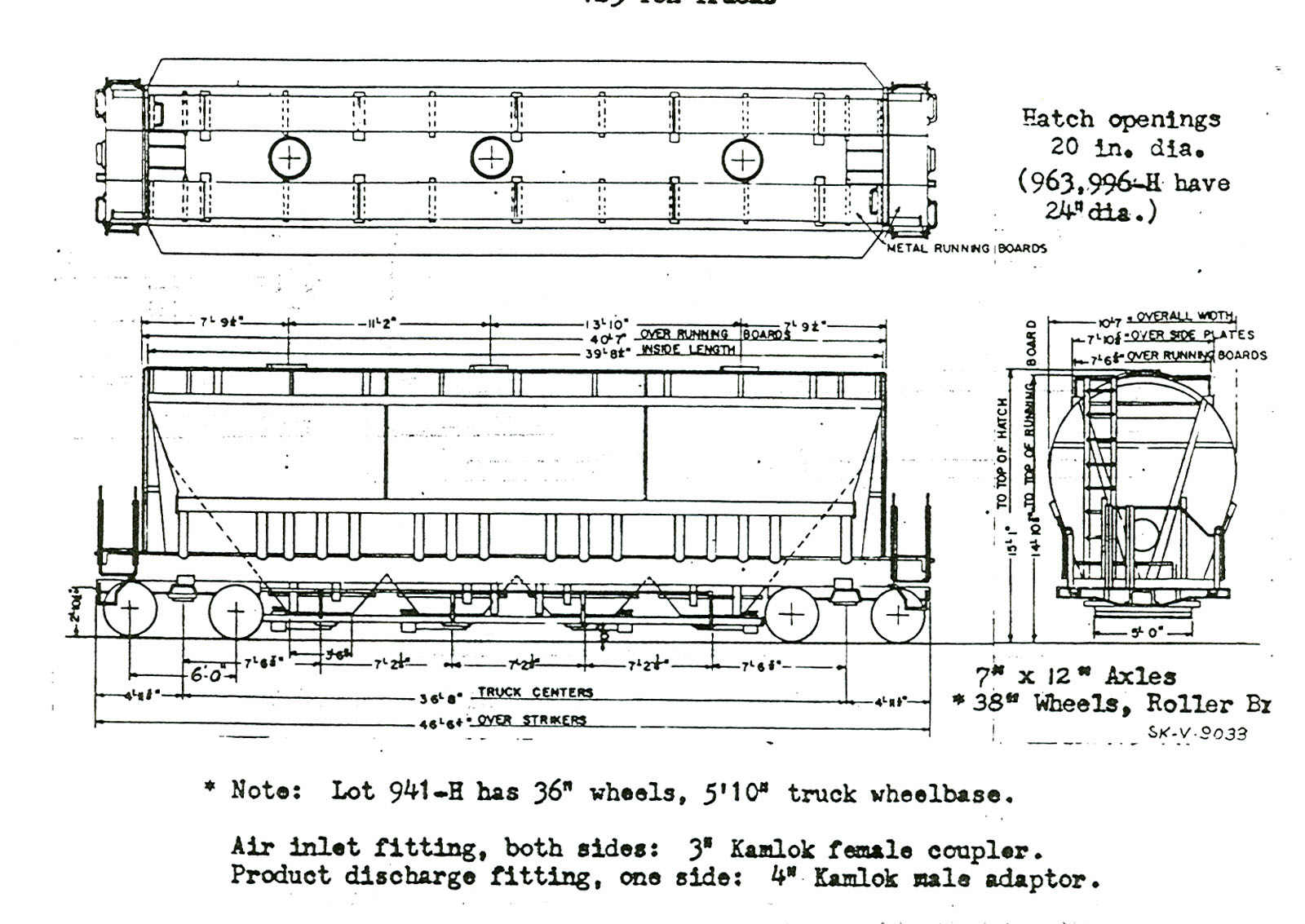
In 1965 American Car & Foundry delivered 75 Flexi-Flo covered hoppers to the Central under lot # 963-H. These cars were numbered 885825-885899. In 1966 the Milton Company built 120 Flexi-Flo covered hoppers for the NYC under lot #996H. The cars were numbered 885680-885799.
100 Ton Covered Hoppers
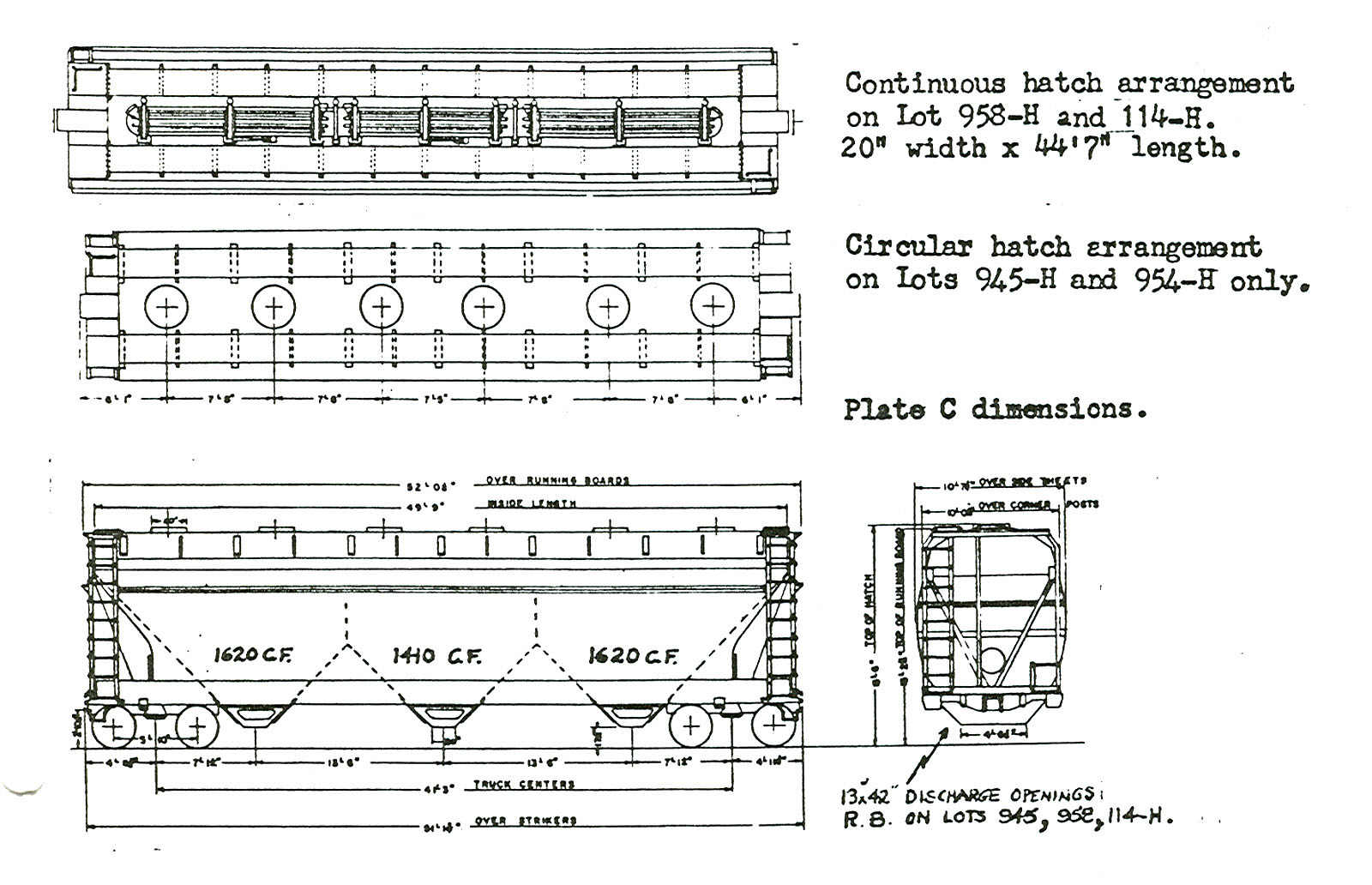
Starting in 1964 the New York Central ordered 97 three bay covered hoppers with a capacity of 4.650 cubic feet from American Car & Foundry under lot #945-H. These cars featured circular hatches, were built to Plate C standards and carried road numbers 886000-886096. 

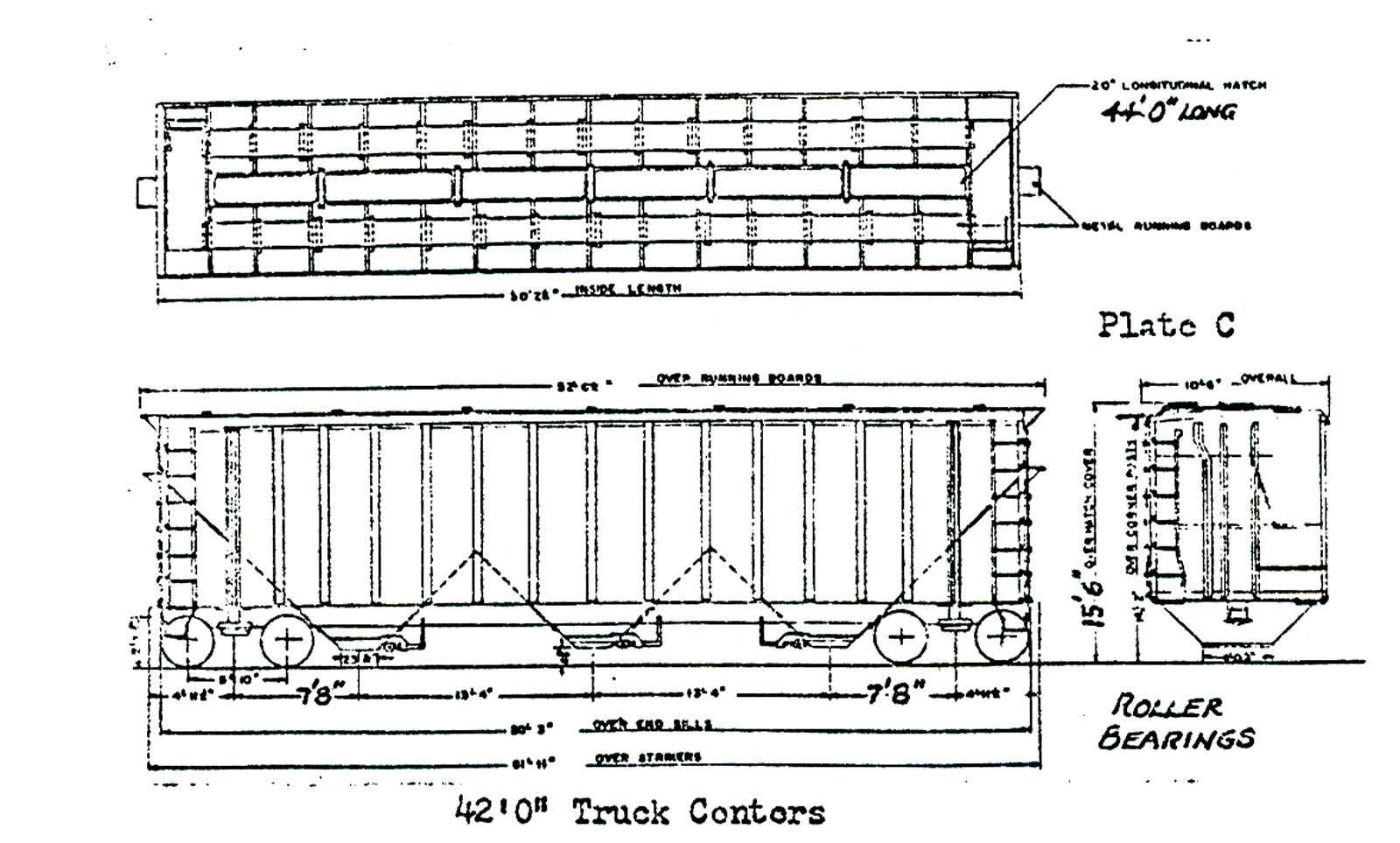
In 1965 GATC built 50 three bay covered hoppers with a capacity of 4700 cubic feet under lot #946-H. These cars had exterior posts, continuous hatches and were also built to Plate C standards. The cars carried road numbers 886176-886225.
Other Covered Hoppers
NYC 886813 is part of a 100 car order (886726-886825) built in 1967 by ACF under lot # 114-H. The prototype however had continuous hatches, not circular hatches and three bays not four like this model.
Covered hopper 892086 was part of a 184 car order (892000-892183) built in 1967 by ACF under lot #131-H. The below model has three bays instead of four like the prototype. C'mon man!!...
NYC 892133 is part of the #131-H order mentioned above. This car has the correct number of bays but has circular hatches instead of continuous hatches like the prototype. Ugh...
Insulated Boxcars
NYC 78746 was part of a 50 car order (78700-78749) built by Despatch Shops in 1964 under lot #976-B.
NYC 78798 was part of a 50 car order (78750-78799) built by North American in 1964 under lot #953-B. The cars in this group were assigned to Corn Products Company service.
Non Revenue Equipment
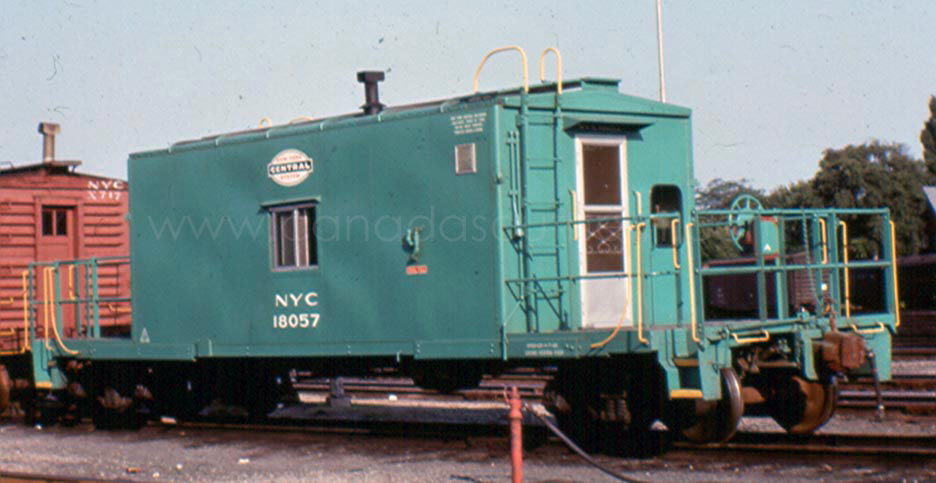
In the 1960s the New York Central sought to replace its aging wood caboose fleet with new steel cabooses for transfer service. NYC 18087 is part of a 50 car order (18056-18105) built in 1966 by Despatch Shops under lot #977. The cars in this lot were converted from Lot #703-F boxcars.
Closing of Part 2
We'll close it out here for today. The New York Central System has upgraded its physical plant with improved track, centralized traffic control, state of the art super yards and new rolling stock to better meet the needs of their shippers. What the NYC needs to do now is provide reliable motive power to deliver the goods so to speak. We'll see how that went in our final installment that will be posted tomorrow.
Thanks for reading!!!
See you tomorrow!!!


Saturday, January 17, 2026

The New York Central System In Transition Part 1

 Greetings All,
The New York Central in Transition Part 1

Welcome to this three part series of the NYC in the lightning stripe to cigar band and road to the future transition. At the end of 2025 my New York Central System motive power, passenger and freight rolling stock enjoyed the center ring under the big top in the circus that is the New York Central Train layout.
During this time I did some research into the overall operations of the 1:1 NYC to see what if anything I could use for my modeling and operations and realized that the railroad and the industry as a whole was in a major transition from around 1956 thru 1967. This is something I've overlooked in the past so down the rabbit hole I went.

When thinking of the word transition as related to railroading the first things that comes to mind is the steam to diesel transition where first generation motive power vanquished the steam fleets of our nations railroads.
Another big transition that came in the 1950s when the envisioned post war prosperity that the railroads were confident would happen did not, especially for the New York Central. Lets take a look at this pivotal time frame for the NYC that was close to bankruptcy but under Alfred Perlman fought that off to become at least marginally profitable.
A Not So Brief Backstory
The New York Central System was a huge railroad, a system after 1935, operating just over 10,000 miles of track in ten states and two Canadian provinces and its passenger trains were a reflection of its overall service and prestige. Known primarily for its 20th Century Limited the Central's first and foremost duty was the transport of freight. Firmly entrenched in the heart of industrial America the NYC moved a tremendous amount of tonnage and in later later years competition with the Pennsylvania Railroad that served virtually the same market became especially severe on account of their relatively short hauls compared to trans-cons like the Santa Fe.
"New York Central System: The Pittsburgh & Lake Erie Railroad Company." by smallcurio is licensed under CC BY 2.0.
1948 A Pivotal Year
A press release in Railway Age reported that the New York Central will completely re-equip twenty eight of its principal passenger trains this year with streamlined cars according to NYC president Gustav Metzman. Almost as many new cars will be added to numerous other NYC passenger trains from orders dating back to 1944.

In all the NYC ordered 239 cars from Budd, 354 from Pullman Standard and 128 from American Car & Foundry augmented by the refurbished cars from pervious Pullman-Standard order of 1938-1940.

Schedules remained stable after 1948 until 1956 when the effects of airline and highway competition began to manifest itself and ridership plummeted.
"New York Central Train 85 at the west end of the Beaver Bridge, Beaver, PA 9-11-1950" by over 26 MILLION views Thanks is licensed under CC BY-NC-SA 2.0.
NYC Passenger Car Timetable Comparisons
April, 1949 timetable (form 1001) listed 136 trains in 71 tables.
April, 1955 the timetable listed 114 trains in 54 tables.
April, 1957 the timetable listed 115 trains in 48 tables.
April, 1958 the timetable listed 83 trains in 44 tables. Gone were the long distance connections to the west coast.
April, 1963 the timetable listed 46 trains in 18 tables.
April, 1967 the timetable listed 24 trains in 6 tables.
November, 1967 named trains were removed from the timetables and were now running only as numbered trains. Gone was the 20th Century Limited and other crack passenger trains.
December, 1967 with the Penn Central merger on the horizon the NYC combined what trains were left and listed 8 trains in 10 tables. 
"Private Rail Car - Hickory Creek" by Luxury Train Club is licensed under CC BY-SA 2.0.
Gustave Metzman exits and
William R. White takes the helm
Mr. White at the time of his appointment in the early 1950s was president of the Delaware, Lackawanna & Western Railroad in which the NYC had a vested interest. Mr. White was a railroad man from the old school, rising thru the ranks of the Erie RR before going on to management positions.
"DL&W , FT 604, E'Bound, Near Coxton Yards PA -1959 unkwn" by over 26 MILLION views Thanks is licensed under CC BY-NC-SA 2.0.

Mr. White toured the NYC extensively to assess the NYC's problem areas and went to great lengths to improve the manner in which the railroad addressed the needs of shippers, employees and on-line communities.

By 1953 Mr. White's work began to pay off. The top heavy management had been cut back, dieselization continued, property taxes were lowered and new train schedules were implemented to improve car utilization. Repairs to track and rolling stock were having a positive effect as freight began moving more smoothly over the line once more. 
"NYCRR #8321 Alco RS-3" by CaptainCutler is licensed under CC BY-SA 2.0.
Passenger operations were trimmed as there had been a 70% decrease in ridership on many runs compared to previous years due to the huge inroads that had been made by automobiles and airlines.

In June, 1953 the ICC issued a decision regarding the division of line haul revenue between connecting railroads. Prior to this the division was tilted in favor of the Western roads where line haul distances were much greater. 
"NYCRR #8341 Alco RS-3" by CaptainCutler is licensed under CC BY-SA 2.0.
The new division of line haul payments split the revenue equally and the NYC benefitted to the tune of $8 million a year in additional revenue. But ill winds continued to blow, this time in the form of Robert R. Young.
Enter Robert R. Young
Mr. Young, president of the C&O RR, was an enthusiastic promoter of rail passenger service who began a six year battle for control of the NYC which he accomplished in 1954. During the battle for control passenger travel had changed and in 1954 the railroad was in serious financial trouble.

When Mr. Young assumed the role of CEO New York Central passenger service was losing $38 million dollars a year. Mr. Young ballyhooed his planned Train X, a streamliner of unproven technology that would reverse this loss. When Train X was unveiled it was promptly considered a failure and was removed from service shortly thereafter.

The NYC Great Lakes Aerotrain operated by EMD for promotional purposes was another experimental train that debuted in 1956. It was moderately more successful than the Train X which was a disaster and went on to barnstorm the country on other railroads.
"Aerotrain No.3" by hugh llewelyn is licensed under CC BY-SA 2.0.
 Alfred Perlman To The Rescue
Mr. Young hired Alfred Perlman who had saved the D&RGW RR from bankruptcy to be the NYC president. Mr. Perlman quickly set to work reorganizing the moneymaker freight operations. He also began talks with rival Pennsylvania Railroad about a merger. 
"Alfred E Perlman Prelinger archive" by Producer: MPO Productions Sponsor: New York Central Railroad is licensed under CC PUBLICDOMAIN N/A.

An Untimely Death
Tragically Robert R. Young committed suicide in late January, 1958. President Perlman became CEO and quickly turned his attention to the hemorrhaging passenger service.
"Robert R. Young historical marker IMG 6059" by Billy Hathorn is licensed under CC BY-SA 3.0.
Keeping Afloat
Trying to recoup some of the huge investment in the passenger trains made in the post war years the NYC began selling off much of its once heralded Great Steel Fleet after the schedule realignment of 1958 thru the early and mid 1960s to mostly to NdeM, CN and Ringling Brothers among others. 
 "RBBX Sleeper Car" by Lexcie is licensed under CC BY-SA 3.
Passenger Traffic Adjustments
Not being able to compete with the federally subsidized airlines and interstate highways that ate away at its traffic bases during this time frame the NYC began using their ground breaking Flexi-Van fleet and other express traffic on the headend of their passenger trains to try and offset some of the train's losses. This made for very long trains while the headend traffic had it's own costs.
"File: South Bend NYC Aug 1962 2-20.jpg" by Lawrence and David Barera is licensed under CC BY-SA 2.0.

"Two New York Central E8As at Hudson, NY" by railfan 44 is marked with Public Domain Mark 1.0.

We'll cut it here for today and pick it up tomorrow with

Forward Thinking at a Critical Time
President Perlman addressed the need for cost cutting, improved infrastructure, efficient operations, and reducing labor costs by using both innovative and draconian measures to save the railroad.

Thanks for reading!!
See you tomorrow!!

Saturday, January 10, 2026

Locomotive Spotlight #1-2026 / New York Central RS32 #8040

 Greetings All,
Locomotive Spotlight #1-2026
New York Central RS32 #8040
Welcome to another post in the continuing Locomotive Spotlight series. Today the spotlight will shine on a used Atlas Trainman NYC Alco RS32 #8040 that joined the fleet in mid December, 2025. Lets take a look at the prototype and the model.
Prototype Information
The locomotive horsepower race was in full stride by 1962 when Alco introduced the 2400-hp RS27 (DL640) and 2000-hp RS32 (DL721) in an effort to stay ahead of competitors General Motors and General Electric. 

Powered by a new V16-251C prime mover, the two road units were precursors to Alco's soon-to-be-announced four-axle Century series C424 (DL640A) and C420 (DL721A). Neither of the two four-axle models gained wide acceptance.

Designated as a "DL721" by Alco, the 2,000 hp RS-32 was intended to compete with EMD's GP20 and GE's U25B locomotives. Thirty Five units were produced, with twenty five ordered by New York Central (8020-8044) delivered in 1961 and 1962. The NYC RS32s were later renumbered to 2020-2044 for the pending merger with the Pennsylvania Railroad.
The "launch pad" at West Detroit was a frequent Alco hang-out. (Ray Sabo photo, March 1967)**

When new the New York Central assigned the RS32s to its trademark Flexi-van service or to hot NY-4/NY-2 meat trains. Later the RS32s could be found in both road and local freight assignments.

"New York Central Alco RS32 2038" by Digital Rail Artist is marked with CC0 1.0.

Ten units were ordered by the Southern Pacific (7300-7309) in 1962. Southern Pacific's units were initially used in road service and could also be found leading hotshot trains up and down the California coastline. 
"SP 7302 at Lenzen service track Feb 1966xRP" by drewj1946 is licensed under CC BY-SA 2.0.

The SP RS32s were later renumbered from the 7300 series to the 4000-4009 series and later settled into local freight service in San Francisco's "commute" territory. Here they were sometimes called upon to rescue stalled commuter trains. They later migrated across the system, ending their SP careers in Texas during the late 1970s with various other Alco models. 
"Southern Pacific Alco RS32 4002" by Digital Rail Artist is marked with Public Domain Mark 1.0.

Both railroads retired their RS32s during the late 1970s. Some of the RS32s found homes on short line railroads and continued to soldier on.
"DL 211 Alco RS32" by eisenbahnstudio is licensed under CC BY-NC 2.0.
Model Information
From Atlas
Atlas Trainman® locomotives and rolling stock are less detailed than Atlas Master products but feature rugged construction and molded parts and a budget-friendly price that makes them great for modelers of all ages. The Atlas Trainman HO Scale New York Central RS32 #8040 model was part of their first run of this type of locomotive from Atlas that was released in 2006. A second NYC RS32 #8036 was also offered at this time. 
Over the last twenty years Atlas continued to release these models with the last release being in 2023 at which time the RS32 /RS36 models were upgraded to Atlas Silver products which have more detail and a higher price.
The NYC 8040 Gets Unboxed
The twenty year old Atlas Trainman NYC 8040 model ran well out of the box but only in one direction when being powered by some of my DC controllers. What? So I removed the shell to investigate.
And found to my surprise that the model was DCC equipped!!
After some research I learned that to revert the model back to DC I needed an eight pin DCC dummy plug. Where am I going to get that? Hello, Sir Neal!! After a brief consultation Sir Neal offered sage advice and sent me a pair of dummy plugs that very day. There it is installed under the supervision of 1:87 scale Sir Neal Himself!! 
From the APRR to the NYCTL
For some fun I'm imagining that a short time after the phone call the 1:87 scale two dummy plugs were placed in PC boxcar #149613 and sent out in the next train to Selkirk for quick movement to the NYCTL engine terminal.
Dock workers move the crate towards the forklift.
The crate is carried into the engine shop.
After having the dummy plug installed RS32 8040 eases out of the engine shop.
The RS32 appears to be ready for revenue service but it's not. For whatever reason the Patti-O Paint Shop employees (me) painted the corner handrails white. Ugh... Back to the shop it goes.
That's much better!!
The yellow corner handrails will now allow me to sleep at night.
The 8040 sits on the ready track awaiting it next assignment. Note the semi scale Kadee whisker couplers that came with the model.
The NYC 8040 makes its first revenue runs.
The good nights sleep didn't last long... On January 3rd I painted the 8040 handrails yellow to match prototype photos and the rest of my NYC fleet. Why didn't I do this earlier you may ask. The answer is laziness. 
A few days later we catch the 8040 coupled up to Atlas NYC RS1 9909 amidst some Baldwin S12s and an EMD GP35- Alco PA2 consist in the engine terminal. More on that to follow in a future post!
Shout Out to 1:1 Scale Sir Neal!!
A very big thank you to 1:1 Scale Sir Neal for his advice, generosity and quickly sending the DCC dummy plugs my way so I could get this engine running bi-directionally and into service on the layout.
Final Thoughts and Comments
The twenty year old Atlas 8040 had little wear on the wheels but lots of dust on the shell when it arrived. It looks to have been lightly used and possibly a display locomotive for a time. It cleaned up easily and once the dummy plug was installed it was ready for primetime on the layout. 

The 8040 runs very nicely with my Atlas Penn Central RS32s and may get renumbered 2040 for the pending PC merger.
Additional Links
Wikipedia RS32 page.
The Diesel Shop RS32 page.
American Rails RS32 page.
Atlas RS32 / RS36 Models.
Thanks for reading and watching!!!
See you soon!!!