New York Central Alcos

New York Central Alcos
NYC RS32 #2040 leads a trio of R32s hauling Train NY-4

Saturday, June 10, 2023

Freight Car Spotlight #5-2023 / C&NW Depressed Center 75' Four Truck Flatcar #48019

 Greetings All,

Freight Car Spotlight #5-2023 
C&NW Depressed Center 75'
Four Truck Flatcar #48019 

Welcome to another freight car spotlight. Today's spotlight will shine on the Chicago & North Western Railway and a Walthers model of CNW depressed center flatcar #48019 that I recently purchased during the Train Store Haul in May, 2023. Let's take a look at the CNW first.
Chicago & North Western Railway
"Chicago and North Western Railway" by contemplative imaging is licensed under CC BY-NC-SA 2.0. To view a copy of this license, visit https://creativecommons.org/licenses/by-nc-sa/2.0/?ref=openverse.

The CNW was a class one railroad that was chartered in June of 1859. The CNW purchased and merged several other railroads between 1959 and 1893 serving the upper mid west and accumulated large tracts of land in the upper peninsula in Michigan. 
"Chicago & North Western Railroad Map - 1977" by vxla is licensed under CC BY 2.0. To view a copy of this license, visit https://creativecommons.org/licenses/by/2.0/?ref=openverse.

By 1899 the CNW had rostered 1,380 locomotives. 1,176 passenger cars and 49,484 freight cars. Changing traffic patterns into the mid 20th century eroded the CNWs rail traffic. After nine years in bankruptcy the CNW reorganized and rapidly dieselized their locomotive fleet.
"Boone, Iowa, CNW, Chicago North Western Railroad, Train, Boone Yard, Engine, Locomotive" by photolibrarian is licensed under CC BY-NC-ND 2.0. To view a copy of this license, visit https://creativecommons.org/licenses/by-nd-nc/2.0/jp/?ref=openverse.

The CNW opened Proviso Yard in 1929 which was the largest freight yard at the time with 260 miles of track and a 20,000 car capacity. Potatoes from the west were the main loading along with sugar beats and huge amounts of wheat and corn.
"Proviso Yard's new nerve center" by mod as hell is licensed under CC BY-NC-SA 2.0. To view a copy of this license, visit https://creativecommons.org/licenses/by-nc-sa/2.0/?ref=openverse.

In 1972 the Chicago North Western Railway was sold to its employees and became the Chicago North Western Transportation Company but retained the CNW reporting marks. 
"Yard Crew" by docmoreau is licensed under CC BY-NC-ND 2.0. To view a copy of this license, visit https://creativecommons.org/licenses/by-nd-nc/2.0/jp/?ref=openverse.
 
The "employee owned" heralds started to appear during this time.

In 1985 the CNWTC transferred their stock to the CNW Corporation which took over operations. More stock acquisitions followed and ultimately the CNW was purchased by the UP in 1995. UP commemorated this with the EMD SD70ACe CNW heritage unit #1995


"Employee Owned!!!!" by Patrick Dirden is licensed under CC BY-NC-ND 2.0. To view a copy of this license, visit https://creativecommons.org/licenses/by-nd-nc/2.0/jp/?ref=openverse.
  
Depressed Center Flatcars Prototype Info
Since their inception railroads have been called upon to carry extremely heavy and oversized loads often using specialized equipment like this Schnabel car. Note the tree trimming this car did along the way!
"A reactor vessel" by NRCgov is licensed under CC BY 2.0. To view a copy of this license, visit https://creativecommons.org/licenses/by/2.0/?ref=openverse.
 
In service, the smaller four truck 75' depressed center flatcars are used to carry large and bulky loads such as transformers, machinery and military equipment. All of these loads would exceed clearance restrictions if moved on standard equipment.
"Transformer component on hvy duty depressed center flatcar" by john_pittman is licensed under CC BY-NC-SA 2.0. To view a copy of this license, visit https://creativecommons.org/licenses/by-nc-sa/2.0/?ref=openverse.

Loads of this type are also extremely heavy and the load limit for these cars(combined weight of car and load) is almost 200 tons. The cars are built with high strength low alloy steels to help conserve weight and spread the weight among the two high capacity four axle trucks at each end of the car. 

With little to no room beneath the car, each set of trucks has its own air and hand brakes which are mounted on platforms at each end as seen on this well done model.
 
Depending on the types of cargo the car may be subjected to numerous restrictions while in transit. Speeds are kept low, usually 25 to 35 mph and the cars cannot be humped. With some types of cargo idler cars(generally empty conventional flatcars) may be placed at each end to improve train handling or increase clearance between the depressed center car and the others in the train.

If the load is especially tricky the car may be moved alone or with idler cars as a low speed extra and be restricted to daylight movements so clearances and track conditions can be monitored safely.

The Walthers Model
In the recent train store haul in early May I found the below Walthers kit of a C&NW #48019 four truck 75' depressed center flatcar that was sealed in the box.

The Build
As reported in a prior post the Layout Standards used for my model railroad rolling stock will be used for this model. This includes adding metal wheelsets, painted wheel faces, painting the trucks flat brown, Kadee knuckle couplers, Testor's Dullcote, touching up the paint as needed and a roll test. I won't be able to add additional weight to the car but may address that with the loads.

The kit comes with some prototype information. Note the kit includes plastic wheels, black trucks and horn hook X2F couplers.

On the flip side are the assembly directions which look pretty straight forward. Three weights are included that fit snugly into the models frame.

The car is basically assembled. If you look closely there are "dots" of unpainted styrene from cutting the parts from the sprues.

The unpainted styrene is also visible on the parts on the deck. The bare styrene will be painted with burnt umber.

To better secure the coupler box lid and eliminate the coupler sag I cut off the little push pins that held the lids in place. I then drilled a small hole and used some little screws that once held my talgo mounted Bachmann couplers in place.
 
Much better!!

The C&NW 48019 is mechanically ready for service. The trucks have been sprayed with red primer and both the trucks and wheel faces have been brush painted with burnt umber 

A Walthers transformer load fits and looks very good.

A Francis Style Turbine makes a nice looking load for this car.

On another day a Caterpillar heavy equipment load heads towards Empire City Caterpillar.

Good thing we verified this load with the Clearance Bureau in Philadelphia, PA to make sure it would fit thru the tunnel!!  

Train BP-41 shoves the oversized load towards the Bedford Park Ford Plant. A brakeman protects the shove move.

The BP-41 passes Bedford Station. 

The oversized crate containing a proprietary assembly line machine is shoved into the Ford Plant.

Building and securing the oversized crate
A few months ago I purchased two packages of 1:87 scale lumber from an ebay seller in Hungary with the intention of using it for an oversized load on a depressed center flatcar. 

However, the Hungarian wood as it has become known, was too long for the three PC depressed center flats in the fleet. With the purchase of the C&NW car the laser cut lumber strips could be built as is and it would fit the car without a lot of cutting.
 
A Bachmann under track uncoupling magnet fit this car perfectly and attached itself securely.

The magnet fits into the recess under the crate and holds it firmly in place on the car. The frame is made from hobby sticks from a local store.

Checkout this electric transformer move!

Final Thoughts and Comments
The addition of this "specialized car" to my fleet and the associated loads allows me to run what are known as High & Wide or Dimensional Loads. Movements of this type are visually interesting, move slowly in most cases and would require some careful handling and dispatching during an operations session. 

Adding and building two new transformer kits from Walthers gives me the option to run trains like the one in the video with all of the necessary components needed to get the transformers up and running. The wire loads from PC Ralph are perfect for this train.

Additional Reading and Links
CNW 48019 at Marshalltown, Iowa.
CNW Depressed Center Flatcar at Minneapolis, MN Note the ACI label and incorrect date and car number.
Chicago & North Western Railway history from wikipedia.


Saturday, June 3, 2023

Putting New Rolling Stock into Revenue Service

 Greetings All,

Putting New Rolling Stock into Revenue Service
With new acquisitions of rolling stock from the train store haul comes new work for getting these new freight cars into "revenue service". Making sure the rolling stock meets layout standards is only the first step now that car card and waybill operations have been instituted and I seek more prototypical operation from my models.

NMRA and Layout Standards
The National Model Railroad Association (NMRA) set forth a list of recommendations and standards for modelers to follow to maximize the reliable running for their locomotives and rolling stock. These include but are not limited to track curvature, rolling stock weight, switch points, wheel spacing, coupler height, etcetera. See the below NMRA link for more.

I started putting some of these standards into place over twenty five years ago for my own locomotives and rolling stock and most recently took to adding additional weight to the rolling stock where warranted. I continue to keep the fleet up to what I call my own layout standards.

Minimum Layout Standards for Rolling Stock
Free rolling metal wheels, wheel faces painted with black or burnt umber, knuckle couplers with metal springs preferably Kadees, a spray of Testor's Dullcote to the shell at minimum, trucks and underframe painted with flat black or brown depending on car color, and additional weight. 

For today we'll focus on the Athearn Ready to Roll BNFE Western Fruit Express 57' Reefers that I purchased as part of the great train store haul documented in the prior blog entry.
 
First and foremost is the addition of Kadee Couplers and checking the coupler and trip pin height with the Kadee height gauge.

The shell has been sprayed with Testor's Dullcote. Additional weight, a more recent layout standard, has been added. For a 57' car I use a total of one ounce.

Do the wheels turn freely. In this car they did not. I drilled out the trucks slightly and improved the axles rolling ability.

It rolls freely now!

Now that two out of the three 57' reefers are up to layout standards its time to put them into revenue service. The third reefer did not meet layout standards and required additional work. More on this car at the end of this post.

A Burlington Northern Western Fruit Express Story
In the Classic Trains Spring 2021 magazine article titled "The Cherry Letter" author Robert J. Kale tells of his experiences working in the Security & Freight Claim Prevention Department for the BN at Northtown Terminal in the Twin Cities in 1974.
"BNFE" by ATSF104 is licensed under CC BY-ND 2.0. To view a copy of this license, visit https://creativecommons.org/licenses/by-nd/2.0/?ref=openverse.

"Around mid June Washington state cherries began to move to Chicago by rail thru Minneapolis and continued into August. These were considered high value loads and the "Cherry Letter" issued to each patrolman made it abundantly clear that cherry car shipments arriving at or located in Northtown terminal must be inspected and patrolman were expected to drop everything to find and inspect and cherry shipments passing thru the yard. Failure to do so would result in a strong personal reprimand or even dismissal".
"BNFE" by ATSF104 is licensed under CC BY-ND 2.0. To view a copy of this license, visit https://creativecommons.org/licenses/by-nd/2.0/?ref=openverse.

"The group that maintained and serviced the refrigerator cars for BN was known as Western Fruit Express. WFE had an office at Northtown and a small work force. The S&FCP and WFE personnel performed the same cherry car inspections but only the WFE had the ability to fuel and adjust or repair refrigerator car equipment. Apparently the S&FCP were conducting cherry car inspections to ensure the WFE did its job". Author Kale goes on to tell an interesting story about one night dealing with the cherry cars. 
 
Into the Rabbit Hole of Model Railroad Operations
with Car Cards and Waybills
After beginning to use the car card and waybill model railroad operating system for my railroad I joined the Operations Special Interest Group to further my knowledge for prototypical operation of my freight car fleet.

Moving the BNFE Reefer cars from an off layout shipper to an on layout consignee offers some interesting prototypical operations following some of the AAR car service rules of the late 1960s and special requirements for refrigerator cars.

Western Pacific Fruit Express Reefers Car Movements
After the BNFE Western Pacific Fruit Express 57' reefers have arrived in Terminal Yard their first move is to Yard 'A' for Perishable Protection Service Protection inspection.
 
The Yard 'A' switcher picks up the reefers from Terminal Yard. Remember special cars require special treatment.

The WFE reefers are spotted in Yard 'A' for perishable protective service inspection and refueling of their diesel fuel tanks if needed.

Once the inspection is completed, either in this op session or sometime in the future, the waybill is placed on top of the movement slip indicating the car is ready for delivery to its consignee, in this case Empire Produce in Empire City, NY.
 
Our subject cars, loaded 
with cherries at Flathead Valley Farms in Polson, Montana have been delivered to their consignee, Empire Produce in Empire City, NY.

Once the cars have been made empty the movement slip is placed over the waybill to move the empty cars back to the BN at Cicero, Illinois.

For this to happen the reefers will be taken back to North Side Yard and forwarded in the next transfer run to Terminal Yard. 

Once in Terminal Yard they will be put into an outbound freight train for movement off layout. 
"BNFE" by ATSF104 is licensed under CC BY-ND 2.0. To view a copy of this license, visit https://creativecommons.org/licenses/by-nd/2.0/?ref=openverse.

After they are returned to the BN they will get loaded off layout for other on layout and one off layout consignees.
"Refrigerator car 2" by kev_walsh is licensed under CC BY-NC-SA 2.0. To view a copy of this license, visit https://creativecommons.org/licenses/by-nc-sa/2.0/?ref=openverse.

When the BNFE Reefers Return
In all instances as the loaded reefers arrive back on layout in Terminal Yard the movement slip (a cut down index card) will have the cars move to Yard 'A" for perishable protection service inspection.   
 "Broken Furnace, color wash" by jronaldlee is licensed under CC BY 2.0. To view a copy of this license, visit https://creativecommons.org/licenses/by/2.0/?ref=openverse.

Repairs if needed will be undertaken in Yard 'A' if possible to minimize delays in delivery.
"Freight Car Repair 1" by Jack Snell - Thanks for over 26 Million Views is licensed under CC BY-NC-SA 2.0. To view a copy of this license, visit https://creativecommons.org/licenses/by-nc-sa/2.0/?ref=openverse.

When the inspection is completed the reefers get moved according to their waybills. Using waybill cycle #2 our WFE reefers have come from Pacific Fruit in Bellingham, Washington loaded with produce for consignee Birdseye at the Terminal Warehouse and Cold Storage complex in East Bedford NY.

Waybill cycle #3 has the cars delivered to Ralph's Grocery Warehouse with frozen fruit juice from Ocean Spray in Aberdeen, Washington.

Waybill cycle #4 has the cars back on the layout as they travel from an off layout shipper, Trident Seafood in Anacortes, Washington to an off layout consignee, Bohack in Brooklyn NY via the LIRR loaded with frozen fish. Frozen fish!!! Why not... When the fruit is not in season this move earns revenue!

Reefers, Reverse Routes, Record Rights
Railroad refrigerator cars, also known as reefer cars, are subject to special handling under car service rules whether owned by a railroad or private shipper. One of these rules is Car Service Directive 145-U.
"ARMN 766205" by contemplative imaging is licensed under CC BY-NC-SA 2.0. To view a copy of this license, visit https://creativecommons.org/licenses/by-nc-sa/2.0/?ref=openverse.

Using Car Service Directive 145-U
CSD-145U suspends Car Service Rules 1 and 2 for the classes of cars covered. Empty cars moving home are accompanied by a revenue waybill without charges showing full routing and all junction points.

Assigned car CSD-145U In effect in the late 1960s refers to certain classes of empty cars including RBL and RPL reefers that were to be returned to the agent at the origin of the last load in reverse of the loaded movement. 

Unassigned car CSD-145U: In effect in the late 1960s. In this case when empty the car is handled "per owner's or lessee's instructions or returned empty or loaded to owner or lessee". Basically the owner or lessee can direct where the car goes when made empty. If the owner or lessee exercised rights to control the disposition of the cars under CSD-145 then they would incur charges under car service rule 5 to the cooperating RRs. 

The simple "car movement slip" that returns the car to the BN at Cicero, Illinois is enough to send the car on it's way home as an assigned CSD-145U car.
"reefer madness" by contemplative imaging is licensed under CC BY-NC-SA 2.0. To view a copy of this license, visit https://creativecommons.org/licenses/by-nc-sa/2.0/?ref=openverse.

Movement Slips and Waybills
While the waybill directs the car towards its intended consignee the movement slip offers additional operations for yard crews. The loaded reefer car handling requirements of protective perishable inspection adds a prototypical car movement or two after the car arrives in the yard but before it departs for its consignee. 

At Terminal Yard this is accomplished in two car movements after the car arrives in a train which has been inspected by the carmen. Move one is to Yard A for the inspection. Move two is either back to Terminal Yard for movement to its consignee or directly to consignees located in the Terminal Warehouse and Cold Storage complex as noted in waybill cycle 2.

To Add the Moves or Not Add The Moves?
In model railroad operations the inspection of arriving trains by the car knockers is basically a non event in some cases. Off camera the train comes in and gets broken down without the delays of car inspection. 
 
Simulating perishable protection servicing and inspection may be performed on a track in the receiving yard without the need to move the car to a separate track or yard if you have an available track that has clearance for an inspection truck or access to a road.
 
My Terminal Yard track spacing only allows for this on running tracks 8 and 9 as seen above which will clog the yard so that is the main reason to move the cars to Yard 'A'. 

Further into the Rabbit Hole We Go
More Car Movements
A movement slip for moving the empty car off layout offers the yard crew a way to block and classify their outbound trains to the various interchanges with other railroads and adds some more prototypical practices and interest.
Empties to Cicero, Illinois
The movement slip for returning the BNFE reefer cars to the BN via the reverse route from the imagined Empire City area of New York looks to be to the BN Cicero Yard in Cicero, Illinois just outside of Chicago where the Penn Central interchanged westbound freight cars with the BN. 
Sample Car Routing
Westbound freight cars traveling to Chicago from the New York City area or in our case Empire City would be placed into NYC / PC Train SLX-1 that would leave 72nd Street Yard in Manhattan or in our case Terminal Yard for Perlman Yard in Selkirk, NY.

After being humped and classified at Selkirk the Chicago bound freight cars would be placed in Train BC-1 for movement to the electronic hump yard at Elkhart, Indiana. At Elkhart all westbound trains were reclassified for direct delivery to western connections.

After classification at Elkhart the BNFE cars would be placed in PC Train BN-1 for delivery to the BN at Cicero, Illinois.
 
Loading Points
When researching for railroads and loading points that make some sense to me for the car(s) in question I use the Opsig Industry Database available online (see link below). All of the shippers for the BNFE cars are served by the BN. This gives the car(s) some imagined movement when off layout.
 
The Case of the Missing Reefer
What about that third WFE reefer? Only two of the three BNFE reefers were put into service for this post. The third 57' reefer did not meet layout standards and was pulled from service as it leaned very noticeably to one side in photos and videos.

After working with the car over the course of several days I was able to correct the leaning by moving the additional weights in the middle of the car to the far side of the factory weight.

The car is upright and the noticeable lean is no more. 

Final Thoughts and Comments
In the span of thirty years I've gone from a loop of track and a few trains to a sizeable fleet of locomotives and rolling stock that in each passing decade in the hobby have benefitted from the adopted "layout standards". 

With reliable track and equipment I'm able to focus more attention to the prototypical aspects of freight car transportation and forwarding which is now a hobby within the hobby for me. A rabbit hole for sure but it opens up new ideas for running the model railroad which in turn adds to the fun.

Additional Reading and Links
Dispatcher's Office Magazine, The Official Publication of the Operations Special Interest Group Transportation Series by Eric Hiser.
BNFE 8853 at Elmira, NY.
BNFE 9303 at Sommerville, Mass.
BNFE 9490 at Burlington Washington. 
Car Service Directives google search.

Thanks for reading!!!
See you soon!!!


Saturday, May 27, 2023

Train Store Haul May 2023

 Greetings All,

It's that time of year again!!!
or another
"hello, my name is John and I'm a trainaholic post!

My local hobby shop, Trainmaster Models in Auburn Georgia, held its annual 50% off sale on used merchandise the weekend of May 4th to May 6th, 2023. With my self imposed 30 day probation and prohibition on model railroad purchases in January now expired I was at the store five minutes after its opening on May 4th.

Here are some of the train goodies I picked up at very attractive prices.

A Walthers Car Shop kit bought on speculation that I might be able to use it for a price I could not pass up. An MRC Control Master controller that I'll use for the upper level of the main layout. An Athearn non powered B&O GP35 for our combined fleet(previously shown in the GP35 follow up post). An Athearn powered AMD103 to help power my Amtrak Superliner train. The new AMD103 will give me a three unit consist with two powered units and one non powered unit.

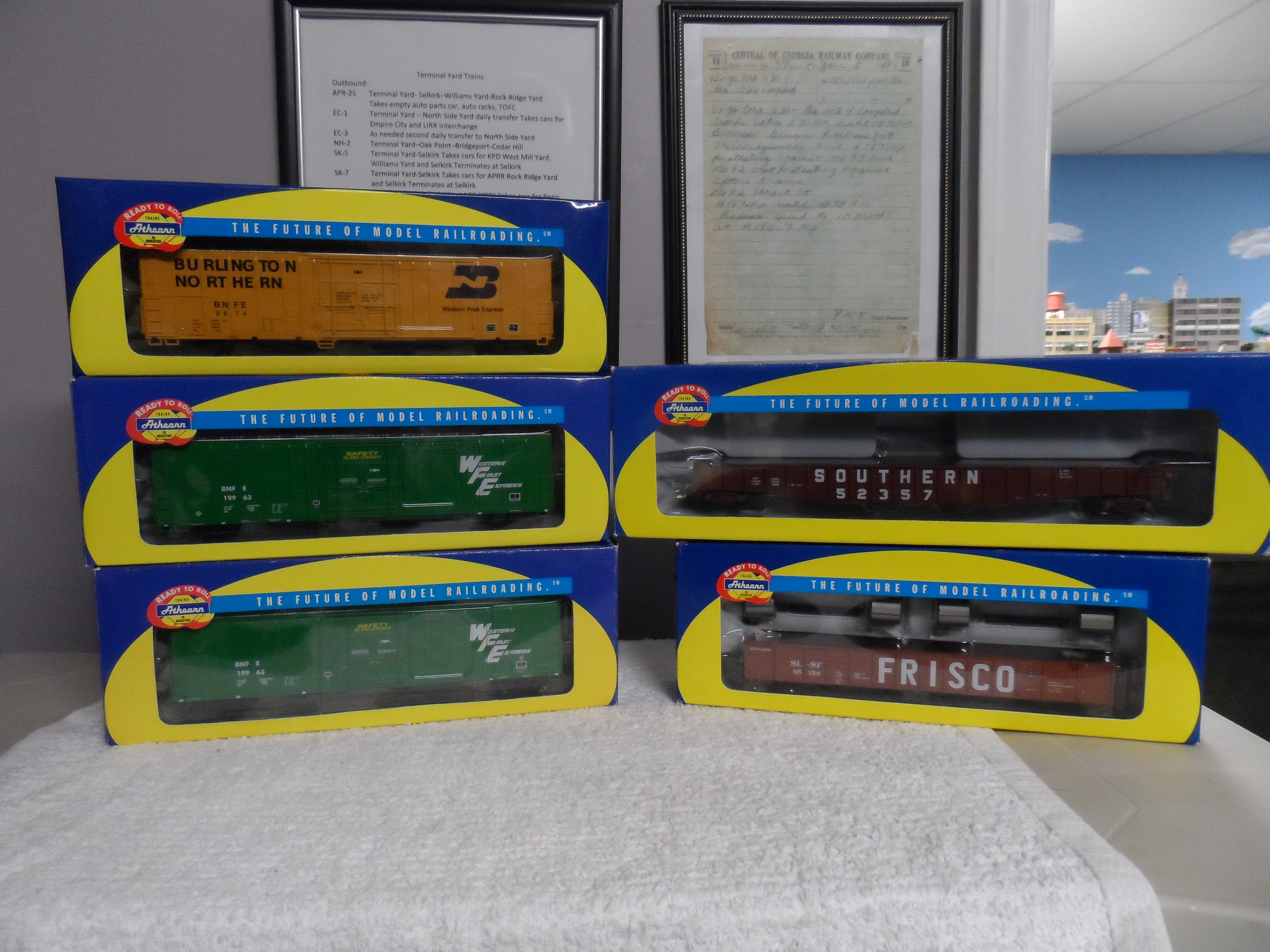
Three BNFE Western Fruit Express 57' reefers to bring fresh western produce to Empire City. One Southern 65' mill gondola and one Frisco 52' mill gondola with steel coils to deliver steel products and serve the industries around the layout. 

Two Santa Fe 45' trailers, a Penn Central tractor and trailer kit, four Flexi Van 20' containers, a Milwaukee Road covered hopper, a Kansas City Southern boxcar and two KCS 45' trailers.

A close up of the Flexi Van 20' containers.

Rounding out the purchases are a Walthers Southern 89' TOFC flatcar and a Walthers C&NW four truck depressed center flatcar kit.

A close up of the depressed center flatcar label.

Getting some of the new items into revenue service
I started working on the easiest items first. All items were sprayed with Testor's Dullcote prior to assembly and have extra weight added except for the TOFC flatcar.

The Flexi-Van containers received an ounce of weight.

The two ATSF 45' trailers under frames were painted flat black. The rims have been painted blue to match the Santa Fe lettering. 

A 1/4 ounce of weight has been added over the wheels and kingpin. A completed car sits on a Walthers ATSF Twin 45 TOFC flatcar that I picked up at last year's 50% off sale.

The new Penn Central green 40' trailer rides on the new Southern 89' TOFC flatcar. I added a 1/4 ounce of weight over the wheels and kingpin and painted the rims green to match the trailer body. I like the way that looks and may do that to the other PC trailers. 
 
The Penn Central tractor and trailer purchase gives me six PC tractors and five PC trailers. PC Tidbit: On June 7th, 1973 the PC won the Golden Freight Car Award for their Trail-Van Program. Having a good number of PC trailers on a TOFC train looks good to me!


The Athearn BB Milwaukee Road covered hopper came with Kadee #5 couplers. Proto 2000 metal wheelsets and one ounce of additional weight were added and the car is now in 
service. 

An Athearn KCS plain jane boxcar that came with metal wheels and Kadee #5 couplers was basically ready to go out of the kit box. I  added an ounce of additional weight and painted the wheel faces flat black. 

Athearn BB Kansas City Southern 45' trailers are now in service. Dullcote, 1/4 ounce of weight above wheels and kingpin and red painted rims highlight these nice looking trailers. The KCS, the latest fallen flag, got a little love this day.

The Athearn Ready to Roll Southern 65' mill gondola handles long structural steel loadings like these steel trusses. Kadee #5 couplers replaced the stock plastic knuckle couplers and the wheel faces were painted burnt umber.

The Southern 65' gondola joins a Walthers EJ&E 65' mill gondola that I've had for awhile. Both can handle these long steel beams without the need for spacer cars. Note the height differences between the two cars.

The second Athearn Ready to Roll Gondola is this Frisco 52' Mill Gondola that came with steel coils and an ACI label. I brush painted the trucks and metal wheel faces burnt umber and sprayed the car with Dullcote.

The little steel coils that came with the car are nice but get lost inside the 52' gondola that should be able to handle more tonnage so I've added a pair of steel coils made by PC Ralph that dramatically enhances the cars look..
We'll close it for today. In future blog posts we'll take a look at bringing the new BNFE Western Fruit Express cars up to layout standards, putting them into "revenue service", building the C&NW four truck 75' depressed center flatcar and adding the Amtrak P42 to the fleet.

Final Thoughts and Comments
I usually start these posts with the "hello, my name is John and I'm a trainaholic, statement. However, I believe I showed some restraint this year as I spent less than at last years big sale. I'll take this as a win!

Also, I focused my rolling stock purchases on brands that had metal wheels and body mounted couplers that would need only minor upgrades such as Kadee couplers. The exception was the MILW covered hopper that had Kadee couplers and stock Delrin wheels.

While the 50% sale was on "used" merchandise most of the items purchased were still new in their respective boxes. The KCS and MILW cars were "used" but had been upgraded by a prior owner. 
  
Thanks for reading!!!
See you soon!!!