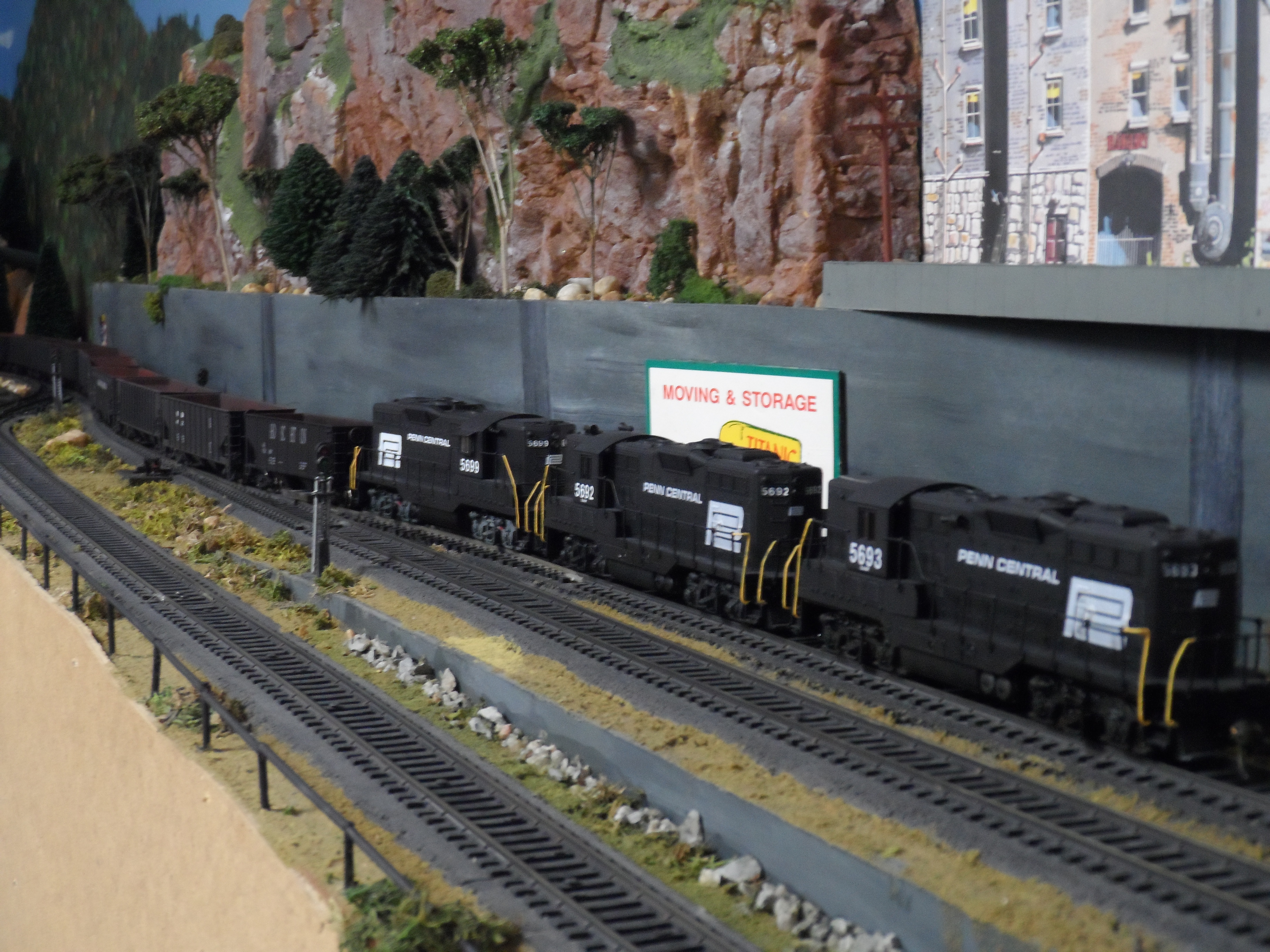
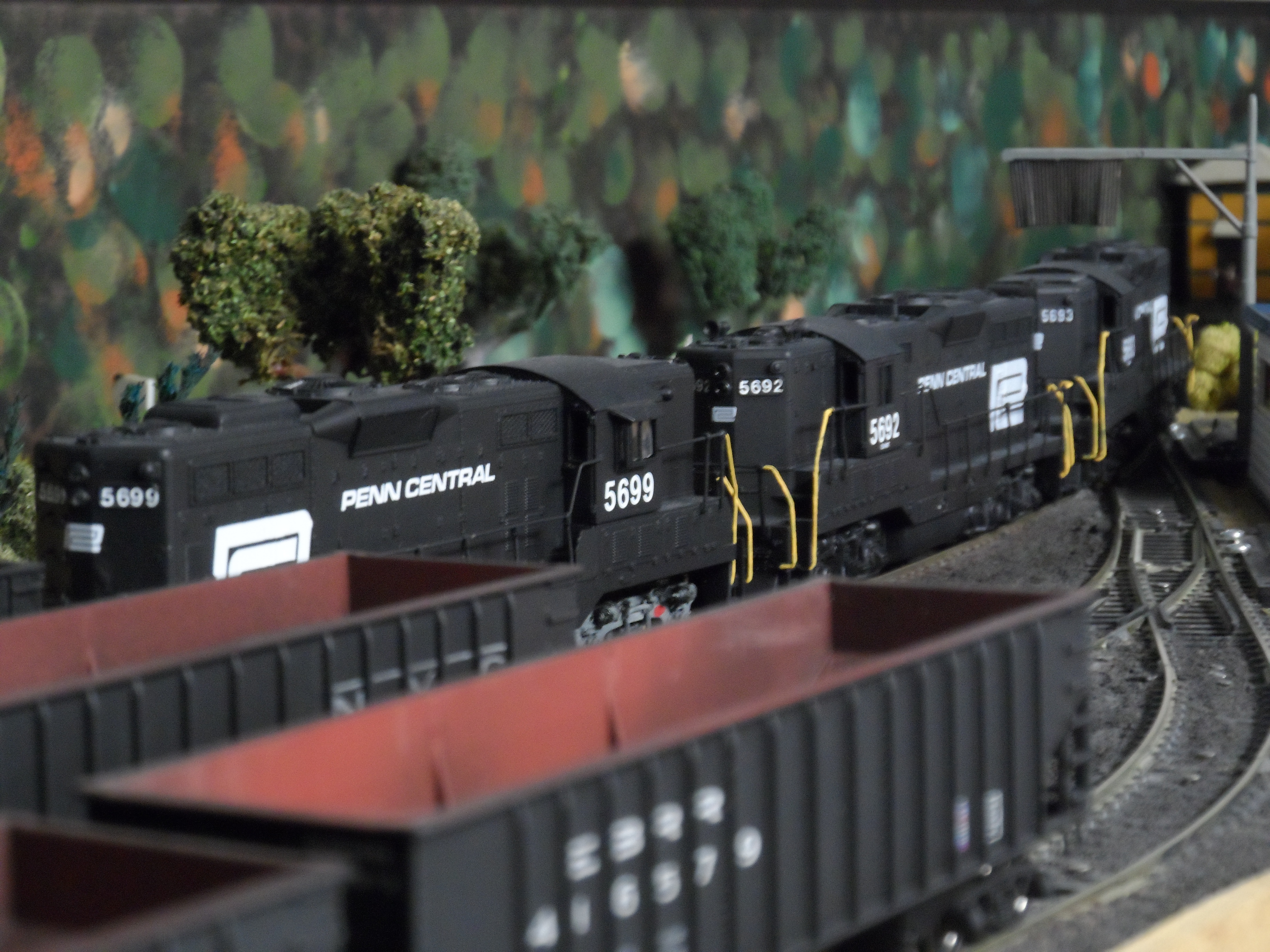
New York Central Alcos

New York Central Alcos
NYC RS32 #2040 leads a trio of R32s hauling Train NY-4

Friday, September 16, 2022

Penn Central Car Movements #95 / Part 1/ The Gathering of Outbound Cars Begins

Greetings All,

Welcome to Penn Central Car Movements #95!!!

PCCM 95 will be another three layout virtual op with my NYCTL interchanging freight cars with PC Ralph's Kings Port Division and Sir Neal's Atlantic Pacific Railroad

We open up the action at Bedford Park Yard with engineer Robert R getting ready to board Alco RS-1 #9921 (formerly PRR #5621) pinch hitting for the ex NYC Alco S-4 usually assigned here.

First job of the day is to pull a pair of empty Evans Coil Coaches from the Ford Plant's steel track to be forwarded to Kings Port Steel their next PCCM load. 

After a runaround move Robert R heads towards the Ford Plant sidings to pull out a trio of empty auto parts cars. PC management continues its tradition of assigning non EMD power to Bedford Park to keep the Ford people happy.

The two APRR and one EBRR 86'ers will be heading back to IDEAL Auto Parts in Rock Ridge NJ for their next PCCM loads.

A pair of loaded auto racks are also pulled from the Ford Plant.

After making his pulls and setouts Robert R has his outbound train together and waits at Bedford Tower for permission to proceed to Terminal Yard as Train BP-12.

Train BP-12 rolls thru Bedford.

Train BP-12 arrives in Terminal Yard.

A short time later Kar Knocker is out to inspect the BP-12. Big Mike working the yard job couples onto the ex PRR cabin car. Robert R has coupled to the BP-41 freight consist for Bedford Park Yard on track #4 and is getting ready for a terminal air test.

Train BP-41 departs Terminal Yard for Bedford Park Yard. Since the train consists of non PCCM cars we'll catch up with Robert R during the Inbound portion of PCCM 95.

Our next PCCM train, CJ-1, the Coal Job, is ready to depart Terminal Yard for Hudson Coal powered by three GP7s.

Train CJ-1 has stopped to clear the switch for Hudson Coal and waits for the brakeman's signal to backup.

The Coal Job shoves into Hudson Coal and starts pulling the loaded hoppers, six of which will be going to Tri Mount Cement in South West Mill.

The Coal Job makes the long pull out of Hudson Coal and shoves the empties back for loading.

The empties are spotted.

The Coal Job is back together and building up air pressure on the Bedford secondary track.

The Coal Job heads for home.

The Coal Job returns to Terminal Yard as Kar Knocker inspects the incoming train.

We'll cut it here for today with Big Mike puling the caboose from the coal train and Kar Knocker ready to blue flag and inspect the consist.

We'll pick it up tomorrow back at Terminal Yard with Alco Joe called for the Bedford Turn, Train BT-27.

Be sure to catch the action on PC Ralph's Kings Port Division and Sir Neal's Atlantic Pacific RR.

Thanks for reading and watching!!!
See you tomorrow!!!


Saturday, September 10, 2022

Operational Enhancements for Terminal Warehouse & Cold Storage

 Greetings All,

Operational Enhancements for 
Terminal Warehouse & Cold Storage

Back in 2018 I expanded the Terminal Yard yard limits to include an engine terminal, TOFC /COFC Track, Terminal Warehouse & Cold Storage, Bruce Electric Equipment, the Empire Power Authority Power Plant, Pier 16, the Pier 16 Grain Silos and some additional trackage to support these industries.

As operational interests increased I was less than satisfied with how I was using these industries and tracks, especially the three building flat Terminal Warehouse & Cold Storage with its eleven car spots.

Looking to increase plausible freight traffic and realism for Terminal Warehouse & Cold Storage(TW&CS) I thought that adding tenants to the large building flat similar to those found throughout the big cities would work and maximize the usage of the industry and tracks. 

After some mulling and research the following new tenants are renting lofts within the complex.

Building #1
Four Car Spots
Bendix Corporation. Manufacturer of auto and truck parts, mainly brake components and compressors. Manufactures and receives brake parts and compressors. Ships same to on layout Bedford Park Ford Plant and off layout consignees.

Fingers Printing Company. Receives bulk paper, bulk ink, and pallets from on layout Drywell Ink and City Pallet. Ships printed materials and waste paper.

Empire Millwork. When doing my operations research I noted that railroads ship a lot of lumber products and my two online lumber industries, Neal's Lumber & Hardware and University Millwork, were getting overwhelmed. Empire Millwork will receive and ship lumber products from off layout, PCCM and on layout industries.

Building #2
Four Car Spots
Montgomery Ward. The amount of freight traffic in and out is enormous. 

Brach's Candy Manufacturer. A throw back to my Dad's days of working at Bush Terminal in Brooklyn NY. Received a lot of sugar, packaging materials etcetera and shipped out finished candy.

Building #3
Three Car Spots
Birdseye. Receives produce, cans, bags, food grade pallets, cleaning solutions and more from on layout and off layout shippers. Ships canned and frozen food products to on layout and off layout consignees. 

Consolidated Grocery Warehouse. Receives and ships all types of wholesale food products including meat products, candy and anything else found in a grocery store.

Annexation
The annexation of Terminal Yard and Pier 16 into the newly formed city of East Bedford was a long time coming. I finally found a name that I could easily adjust and give the location a defined location. What's in a name? In railroading a lot!!

The passenger train station and platform at Terminal Yard track #1 now has an identity and will become East Bedford Station.

Operational Procedures
Opening Terminal Warehouse & Cold Storage to spotting cars at specific door spots opens up some operational challenges and safety issues. With one long siding switching cars in and out needed to be done plausibly, efficiently and safely. I didn't like the idea of just switching the siding whenever a car for one of the tenants came into Terminal Yard thinking this wouldn't be safe and would lead to dock worker injuries and damage claims.

Yard A Is Established
Bush Terminal Railroad (reporting marks BUSH) Operated two float bridges, seven long piers and a large yard known as "A" Yard or Yard "A". At one time this yard handled over one thousand cars a day. A bit much for my needs but an idea took hold.

Yard A would be a two track yard using a pair of seldom used tracks at the edge of the layout and in front of the Pier 16 Grain Silos and used to serve the tenants in the Terminal Warehouse & Cold Storage Complex, Pier 16, thePier 16 Grain Silos, Empire Power Authority and Bruce Electric Equipment.

Traffic Management Needed
We now have tenants and a freight yard and now we need a safe way to get the cars to and from the TW&CS complex. Here is what I think will work for my operations; A TW&CS traffic manager that works with the Yard A crew and provides lists of cars to be switched in and out similar to other big rail served industries. 

Switching Agreements Put In Place
A contract between the switching railroad, owners and tenants of the TW&CS complex is agreed to and stipulates the following; ALL switch moves will take place between midnight at 6:00 AM when the bulk of the industries are closed. Cars requested for delivery, hold at industry, movement within the complex and movement from the complex are to be submitted to the Yard A office by 10:00 PM. We now have an accord to safely move the freight cars in and out of the complex but we do not yet have these freight cars. 

Yard A gets a temporary office to begin operations.

Handling Inbound Freight Traffic at Terminal Yard
Freight traffic for the TW&CS Complex coming into Terminal Yard will be forwarded to Yard A for subsequent delivery to the TW&CS complex. To accomplish this a switch engine and crew will work three tricks out of Yard A. The Terminal Yard yard job will set out cars for complex consignees on a designated track for pick up by the Yard A crew. All cars picked up will be transferred to Yard A.

The Yard A switcher picks up five inbound cars for the TW&CS complex on Terminal Yard track #8 for movement to Yard A.

Handling Inbound Cars Arriving in Yard A
All inbound freight traffic for the various industries served from Yard A will be inspected upon arrival. Cars found with defects will be moved to the R.I.P Track. 
 
Modeling Constructive Placement and Demurrage
An imagined arrival notice would be sent to the consignee of each freight car upon placement of the car in Yard A. Once freight bills and payments were satisfied the freight car would be released for delivery. 

With the car placed in Yard A and the waybill confirmed and shipping charges paid or credited the consignee could request the delivery of his freight car to the specific door spot needed for unloading. 

If the car is not able to be delivered due to reasons beyond the RRs control the car will be considered constructively placed and the demurrage clock will start ticking.

Using older Demurrage Rules charges of one debit per day after 48 hours free time per boxcar and one debit per day after 96 hours free time for frozen loads would be charged to consignees for holding such cars. 

Special Handling Required
All Refrigerator cars containing perishable traffic will be subject to inspection by Perishable Protective Service Inspectors who will verify car temperature, mechanical refrigeration units are working properly and their fuel needs, and whether ice or heaters are needed in the older type ice bunker reefers.
 
Delivery of Freight Cars to TW&CS Complex
The Yard A crew will block the required freight cars at Yard A for delivery to the complex. Once completed the freight cars can be transferred via Terminal Yard tacks #9, #8 and #8E to access the complex rail siding. Once the switch work is complete the Yard crew will take and cars removed from the complex back to Yard A.

The Yard A switcher shoves inbound cars onto track 8E to access the TW&CS complex. Track #8 is behind the turnout throw. Track #9 is on the left.

Freight cars get pulled from TW&CS. The AT&SF and D&RGW Hi Cubes are in Whirlpool appliance service assigned to the EL at Marion, Ohio and have delivered appliances to Montgomery Ward.

A Cotton Belt "Paper Loading Only" boxcar delivers paper rolls to Fingers Printing Company in Building #1

A GM&O boxcar of furniture and an empty PC boxcar are spotted at Building #2 for Montgomery Ward.

Three reefers are spotted at Building #3 for Birdseye and the Grocery Distributor.

Handling Outbound Loaded Cars in Yard A 
Freight cars arriving in Yard A for outbound movement will be subject to the same inspection procedures as the inbound cars. Outbound loaded freight cars and their waybills will be forwarded to Terminal Yard for further movements. 

Outbound cars from TW&CS industries get shoved into Yard A. 

Handling Empty Home and Foreign Road Cars in Yard A
Empty home road cars will be cleaned and readied for local loading. Foreign road empties will be cleaned and used for existing empty car requests per car service rules. Empties not needed will be sent back to their respective railroads to minimize per diem charges. Do not hold foreign empties for possible future loading was the mantra of Penn Central to save money.

After reviewing the car cards and waybills and with the car inspections complete the Yard A switcher brings a cut of cars via track #9 to Terminal Yard for inclusion in the proper outbound trains. 

The freight cars from Yard A get shoved into track #6 which has been designated as the receiving track for the cars coming from Yard A in today's operations.

Putting the Plan into Play
I tested the above procedures by running a sample op session. It took me about 25 minutes to pick up the freight cars in Terminal Yard, complete the inbound and outbound movements for the TW&CS complex and deliver the outbound freight cars to Terminal Yard. This also included blocking the next set of existing cars for delivery to the TW&CS complex. 

No other movements were made at this time and as freight traffic arrives for the TW&CS and other industries served by Yard A I anticipate a lot longer time frame to service all of these industries.

The Yard A Switch Engine idles away as it awaits its next call out.

Final Thoughts / Pros / Cons
Relieving the Terminal Yard switcher from having to deliver freight cars around the yard limits should streamline their yard work.

Adding another railroad job with a plausible purpose should enhance the overall operational scheme and provide additional enjoyment in running layout operations.

As freight traffic starts to arrive in Terminal Yard and Yard A for the other Yard A served industries Yard A may become overwhelmed. But only time will tell and the Yard A job works three tricks to try and keep the yard and its operations fluid. We shall see...

Yard A will make its virtual operations debut next weekend in a three layout Penn Central Car Movements #95 with Sir Neal's APRR and PC Ralph's KPD.

Thank you for reading!!!!
See you soon!!! 


Saturday, September 3, 2022

PRR Focal Orange N5C Cabin Car #477911

 Greetings All,

Caboose / Cabin Car Spotlight #1-2022

Welcome to the first caboose / cabin car spotlight!! On the New York Central it was known as a caboose, on the Pennsylvania RR a cabin car and on the Penn Central after much argument it was known as a caboose or a cabin car depending on who you asked.

Model Information
The HO scale PRR N5C caboose model is a Bowser kit that I purchased in June, 2022 as part of my great train store haul

Here is the kit ready for assembly.

The parts have been dull coated with Testors Dullcote, the factory included weight and additional weights have been painted flat black.

Newly built cabin car #477911 passes Bedford Tower. A big difference between the PRR cabin car and NYC caboose are the thick steel structural supports on the ends of the PRR cars. The cabin cars were built to be placed between locomotives and freight cars and shoved up the Alleghanies and around Horseshoe Curve while their NYC counterparts enjoyed travel on the water level route..  

The focal orange 47911 is a good looking car. I've added extra weight, clear plastic windows, metal wheelsets and Kadee #5s to the car for enhanced looks and operation.

Prototype Information
The Pennsylvania RR introduced their home built N5C cabin car in 1942. The N5C utilized the distinctive round porthole windows and a large streamlined cupola.

The PRR N5C cabin cars were numbered 477820 - 478019.  As constructed the N5C was painted "freight car color" and the roofs were tarred black to prevent leaks. In 1955 the large PRR shadow keystone and "Pennsylvania" lettering were added.
Photo by Vilseskogen courtesy of Openverse.

In June 1965 the cabin car color was changed to focal orange or safety orange with a keystone herald and the word "Pennsylvania" removed. 

The Bowser caboose box lets us know this N5C is in the new style lettering. This would be the last cabin car paint scheme for the PRR. The #54010 is a bit misleading as it is the product number and not the cabin car number. 
 
When the PRR N5C cabin cars were conveyed to the Penn Central they were renumbered 23000 - 23179. Here is a Bowser model that I painted a few years ago.

Penn Central 23045 sports full lettering, a very large number and sub-lettering that tells us this N5C belongs to the Northern Region Canada Division.

Only the PC car in the background tells us the ex PRR RS-1 and cabin car 477911 are resting at Bedford Park Yard just after the PRR-NYC merger.

Final Thoughts
The Bowser kit is well done and provides an accurate representation of the PRR N5C cabin car. The steel supports and steps are a bit fragile and the holes for their pins may need to be drilled out very slightly to avoid damaging them. 

Modelers using the Bowser N5C in model railroad operations should consider adding additional weight as I did when building the kit. Out of the box it is quite light and if you intend on shoving it between freight cars and locomotives the additional weight will help keep the cabin car on the tracks.

All in all these are good looking models and with a little extra work they will be good operating models as well.

Prototype Photos
I couldn't find a photo the 477911 but a 1966 photo of PRR 477913 can be found here.

PRR 477911 was renumbered to Penn Central 23024 and received a full PC paint job. A prototype photo from 1974 can be found here.

You can see the prototype 23045 photographed in 1979 here.

Thanks for reading!!!
See you soon!!!

Sunday, August 28, 2022

Locomotive Spotlight #6 / New York Central F-M C-Liners

Greetings All,

Locomotive Spotlight #6 / 2022
 New York Central Fairbanks Morse C-Liners

Today we'll take a look at the New York Central Fairbanks Morse Consolidation Line locomotives and my own A-B-A set from Proto 1000.
 Prototype Information
Diesel engine manufacturer Fairbanks-Morse entered the diesel electric locomotive market at the end of World War II. The F-M engines used an opposed piston design that employed two pistons facing each other in each cylinder. The advantage was that it produced significantly more horsepower than an EMD, Alco or Baldwin engine of the same cylinder count. 

In the late 1940s F-M introduced 2,000 and 2,400 horsepower locomotives more than a decade before other builders achieved the same power in single engine locomotives. 

In December 1945 Fairbanks-Morse produced its first streamlined cab/car body dual service diesel electric locomotive to compete with the Alco PA and EMD E units. These units were erected at General Electric's Erie PA plant which gave them the nickname Eries or Erie Builts. A total of 82 can units and 28 booster units were sold when production ended.

NYC Erie Builts 
The NYC purchased 14 Erie Builts that were delivered between 1947 and 1949. Of these six were geared for 97 miles per hour and intended for passenger service with the other eight geared for 79 mph and intended for fast freight service.

The 64' long NYC Erie Built A units (#5000-5005) were built for freight operations with a 2,000 HP 10 cylinder, opposed piston diesel engine that rode on A-1-A trucks. #5002 would be repowered with an EMD 567 engine in 1957

Erie Built 5003 idles away at Terminal Yard. The 5003 would also be repowered with an EMD 567 engine in 1957.
 
F-M cab less booster NYC #5101 contributes another 2000 HP to the Erie Built A-B-A consist. 

A single Erie Built was often seen powering the New York Central Pacemaker Freight Trains.

 C-Liners
A total of ninety nine C-Liners were built by F-M at their Beloit, Wisconsin plant between 1950 and 1952. 
Photo courtesy of OldOnliner, thru Creative Commons 

Another sixty six were built in Canada under license. 
 
The New York Central RR's thirty three Fairbanks Morse C-Liners gave the Central more C-Liners than any other railroad. The NYC received the first C-Liner built, #5006 and the last USA built unit #4507. Thru 1952 the Central was one of F-Ms best customers with the purchase of one hundred nineteen FM units.
 
The FM Consolidation Line was the company's attempt to market and erect locomotives with different options like high HP on the same frame. The C-Liners followed the F-M Erie Builts so named for being built in the GE Erie PA factory between 1945 and 1949. The C-Liners took many design cues from the Erie Builts and continued using the same opposed piston engines.
 
The C-Liners came with an eight cylinder 1,600 HP(CFA16-4A) and ten cylinder 2,000 HP(CFA20-4) version for both A and B units. A twelve cylinder 2,400(CPA24-5) passenger unit with a B, A-1-A axle arrangement for A units only.

The New York Central purchased all three of the above models. Eight CFA16-4A units(6600-6607) and four CFB16-4 units(6900-6903) were purchased in 1952 and retired in 1966.

Eight CPA24-5 passenger units (4500-4507). These units would also be repowered with EMD 567 engines in 1955 and 1956. All were retired in 1966 and later scrapped.

Twelve CFA20-4 units(5006-5017) and three CFB20-4 units(5102-5104). All would be repowered with EMD engines in 1955 and 1956 and later scrapped.
 
C-Liner Models
The New York Central Layout regularly runs this Proto 1000 C-Liner A-B-A set. These models are quite rugged with the A units having survived a four foot drop to the floor. After finding all the parts that came off and putting the units back together the only broken piece was the coupler on the lead unit.

CFA20-4 #5008 is still running well after 20 years of service and a big fall. These models have not been afflicted with the P-1000/P-2000 cracked gear problems. Knock on wood!
  
CFA20-4 #5013 burbles away in Terminal Yard as the trio awaits their next call to duty.

CFB20-4 #5102 required a modification to allow it to better mu with the A units. See below for more on that.

The 5000 series C-Liners were assigned to West Springfield for maintenance in order to cover some of the B&A assignments with the Erie Builts and FAs. Their 500 more horsepower per unit than the FAs did improve train speed and their heavier weight increased the tractive effort and low speeds.

An A-B-A set of C-Liners rests in the Terminal Yard engine terminal along side a an A-B-B-A set of FAs and FBs. 

Reliability issues with the C-Liners and Erie Builts allowed the Alcos to usurp the C-Liners as the preferred power to conquer the Berkshires. It took an ABBA set of Alco F1s and B1s to match the power output of the 5000 series A-B-A consist but the Alcos more than proved themselves on the New York Central and Boston & Albany.

Modifications
After adding the B unit I noticed that the B unit ran faster than the A units in Direct Control mode. I removed the circuit boards, hard wired the units and ended up adding a light in the B unit so all units would draw the same amperage. After this the units ran very well together. 

C-Liners in Action

Final Thoughts
The Erie Built and C-Liner models from Proto 2000 have been on the NYCTL roster for over 20 years and continue to provide excellent service. They are rugged, easy to maintain and can pull any tonnage I can come up with.

Thanks for reading and watching!!!
See you soon!!!