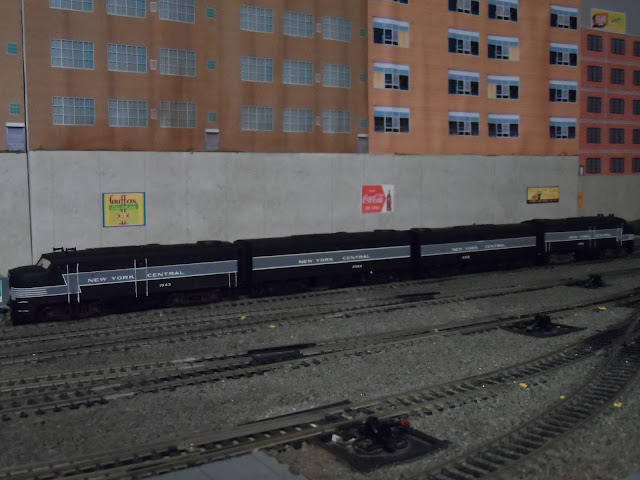
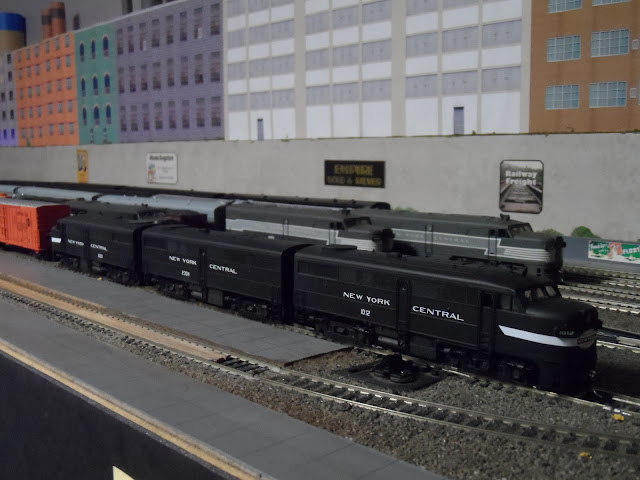
Welcome to my Blog. The scope of this blog is to record the trials and tribulations of building and maintaining an HO scale layout, the trains and all of the ancillary projects that go with it. In 2017 New York Central subsidiary short line Empire Belt Railroad came into existence. The New York Central / Penn Central and Empire Belt are now the major railroads featured.
New York Central Alcos
NYC RS32 #2040 leads a trio of R32s hauling Train NY-4
Welcome to the first virtual op of 2022 as we begin the seventh year of PCCM virtual operations which started on February 3rd 2016. The very first virtual freight car interchange between my NYCTL and PC Ralph's Kings Port Division can be traced back to my blogpost from August 06, 2014!
The original PCCM freight car interchanges were by email until we switched the the blog format. We've certainly come a long way since those humble beginnings!
PCCM 90 will feature my NYCTL layout interchanging freight cars with PC Ralph's Kings Port Division. Sir Neal's Atlantic Pacific RR is on a winter hiatus and should be back for PCCM 91.
We begin year seven with the return of the 1:87 scale Penn Central management and trainmen who have diligently been working both Terminal Yard and Bedford Park Yard.
The Empire Belt RR team led by 1:87 Senior Engineer Sir Neal and PC Ralph are also returning along with LIRR engineer Jimmy Alco.
Jimmy Alco gets the honor of opening the PCCM 90 action bringing LIRR Freight Train MA-3 from Fresh Pond Yard thru Bedford NY towards Empire City and the Empire Belt RRs North Side Yard.
LIRR Train MA-3 rumbles thru Bedford
Jimmy Alco gets clearance at Bedford Tower to enter the High Line and Empire City
Train MA-3 arrives at the Empire Belt RRs North Side Yard with PC Ralph inspecting the incoming train.
Jimmy Alco has dropped the MA-3 consist on track 2 and rolls out of the yard shoving his outbound pickups past the ever watchful Sir Neal and conductor John.
Jimmy Alco makes a quick run to Pizza Land for calzones to go!
Jimmy Alco is back on board his Alcos and brings the outbound train west to collect the caboose.
LIRR Caboose #12 is coupled on and LIRR Train MA-4 prepares to head back to Fresh Pond Yard.
LIRR Train MA-4 passes Bedford Tower as the tower operator gets a whiff of hot calzones from the engine compartment of the lead unit.
Train MA-4 heads back thru Bedford to Fresh Pond Yard.
Next we turn out attention to the Penn Central's Bedford Park Yard where engineer Robert R is ready to board ex PRR Baldwin S12 #8195 and get to work.
The first pick up is Lehigh Valley boxcar #66392 loaded at American Hardware Supply with paint and paint supplies for Amalgamated Container Corp (ACCO) located in Mayfield NY.
A non PCCM EL boxcar gets spotted at American Hardware Supply.
Robert R's next stop is the Bedford Park Ford Plant to pull out a trio of empty 60' boxcars.
The NYC, KP&W and PC/TOC cars are going back to ACME Auto Products also located in Mayfield NY for reloading.
Train BP-12 (Bedford Park to Terminal Yard) heads to Terminal Yard.
Robert R brings the BP-12 into Terminal Yard as both Kar Knocker and Big Mike inspect the inbound train.
Big Mike, running the Yard Job, sets the BP-12 cars onto track #2.
Robert R has coupled the Baldwin S12 to three 86' boxcars that came in earlier on the FAST 50. Kar Knocker has cleared the train for departure which is now identified as Train BP-41 (Terminal Yard to Bedford Park).
Train BP-41 heads back to Bedford Park Yard.
We'll close it out for today at the Empire Belt RRs North Side Yard with the EBRR trainmen preparing to get their yard and trains in order. Note "borrowed" ex PRR U25C #6500 in the EBRR consist.
We'll pick it up tomorrow with the Morning Industrial Job being powered with an EBRR GP18-"borrowed" PC GP9- EBRR GP18 consist.
The EBRR-PC consists above were the idea of 1:87 scale Senior Engineer Sir Neal to balance power and fuel consumption on both EBRR trains moving the tonnage in a two layout virtual op.
The U23Cs (2250 HP) and U25C (2500 HP) give that consist 7,000 HP which should be fine for transfer service in this two layout PCCM. The GP18s (1800 HP) and GP9 (1750 HP) provide 5,350 HP which should be more than sufficient for the switching service in a two or three layout virtual op.
Today we celebrate the 54th anniversary of the Penn Central with our inaugural,
Penn Central Historical Society Three Photo Challenge
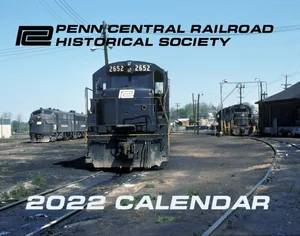
As Penn Central Railroad Historical Society members and Penn Central Car Movements virtual op participants PC Ralph, 1:1 Sir Neal and I are going to do our best to replicate three photos from the PCRRHS 2022 calendar.
With photos from all 12 months in play I chose photos from the months of March, June and December.
Here is my first entry using the March 2022 photo by David Beach. The caption reads in part " Penn Central E8A #4304 leads a three car Train 53 past McKinley Tower in Canton, Ohio."
Penn Central E8A #4317 leads a three car train past a Hohman Ave Tower which was moved to facilitate the photo. The E8A, NYC baggage car, ex PRR and NYC coaches are consistent with the photo.
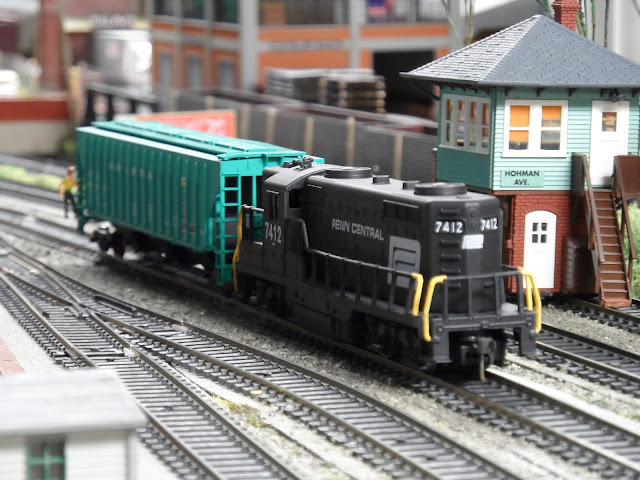
My next challenge photo is based on the June photograph by Stephen J Salamon. The caption states in part "On June 9, 1973, an eastbound local behind GP9 7397 works the DT&I interchange."
GP9 7412 pulls a single green covered hopper with a trainman riding the freight car stirrup past the moved again Hohman Ave Tower. The photo is consistent with the action, a tower and train consist.
My third and final photo challenge photo is based on the December photograph by Lou Adler. The caption states in part "In winter of 1969 a pair of GP40s and a former F7A lead a train westbound under the DT & C&O bridges at Miller Rd in Dearborn MI. The tri-levels are loaded with Chevrolet Novas..."
GP40s 3007, GP40 3175 and former NYC F7A pull trilevel auto racks under the highway overpass. The white PC GP40, orange C GP40, NYC F7A and trilevel auto racks are consistent with the photo.
This was a lot of fun and we plan to do the same with the thrice yearly PCRRHS 2022 POST magazines. The magazines and calendar are available thru the PCRRHS society store.
A recent purchase at a local train show of a virtual ops favorite freight car, the Evans Breadbox Coil Coach, is the inspiration for today's post. Lets take a look at the prototype and models of this unique looking freight car.
The Prototype
The Evans breadbox car made it's debut in 1965 as reported in the November 1965 New York Central Headlight employee magazine. The experimental 100 ton cars featured sliding covers that protected the steel coils and slid open like a breadbox to access the loads. At the time the new cars could handle twice as much tonnage as conventional steel service cars.
The Pittsburgh & Lake Erie became the first railroad to order this new generation of freight cars designed by Evans and the New York Central over a period of five years to haul steel coils according to the New York Central Headlight July/August employee magazine.
The car was dubbed a breadbox car according to the article and was touted as the first major advance in steel coil handling in the last ten years by the P&LE president. The 125 ton cars featured a 50' long continuous trough that permitted heavier loading and gave greater flexibility
The P&LE bought or leased fifty of these cars starting in 1966 and the Bessemer & Lake Erie ten. Their unique covers that protect the steel coils were designed so that one person could easily open the covers which stayed attached to the car.
Unfortunately rough handling mostly by hasty crane operators opening the covers ended the one man operation and the cars were converted to a more industry standard hood like this B&LE car #31002 or had their hoods removed entirely.
The Models
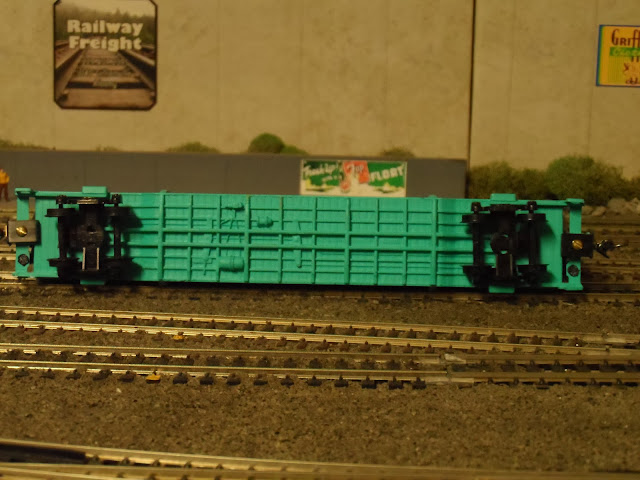
This Evans breadbox P&LE #42279 is a Bachmann product that was a used train purchase. The car is classified as an AAR GBSR; "Open gondola having fixed sides a solid steel bottom and equipped to handle steel coils with cover." The build date is 11-67, the capacity is 230,000 Lbs. The Evans logo is on the left. Above the small New York Central System herald is the classification code 111F. The car number falls within the prototype P&LE cars numbers for this car, 42250-42299.
The car comes equipped with talgo mounted horn hook couplers and plastic wheels. The long tongue of the talgo coupler has been cut away from the trucks and Kadee #5 couplers have been body mounted with 2-56 screws.
Additional weight has been added.
Metal wheelsets replaced the original plastic wheels. The 5/32 drill bit was used to drill the holes for the 2-56 screws securing the coupler boxes and open up the trucks as necessary for the new wheels to roll smoothly. The long tongues cut from the trucks will be used in another project that I'll highlight at the end of this post.
To the proving grounds we go and this car rolls very well.
The P&LE Evans Breadbox cars were also offered by AHM in the same road number but with a matching green hood.
Lionel first offered the car in HO scale which is identical to the AHM car. I think the Lionel cars came with plastic coils.
Bachmann also produced the B&LE cars with road number 31002.
Matching Prototype to Model
Did the P&LE cars come with silver hoods or green ones? The answer is I don't know. Here is P&LE #42268 in 1977 but without hoods. What about the B&LE? The B&LE car looks to have been built with silver hoods as seen in this 1967 photo of B&LE #31001.
Operations
Opening the hoods on the HO scale models is probably as troublesome as it became on the prototypes. For many years my breadbox cars sat in the purgatory box until around 2014 when I saw them in operation on PC Ralph's PC RalphVids youtube channel. Ralph had the cars looking good and running well as they serviced Kings Port Steel on his layout. Shortly after that I bought a pair of B&LE models.
At this time I was in communication with Ralph and received his permission to post an imaginary interchange of the cars that would go to the KP&W shop for rebuilding and return to my layout ready for service. Here they are in 2014 on their way to the KP&W Shop for rebuilding.
Here they are again in 2014 now in revenue service after being rebuilt and sold to the imaginary JTRX freight car leasing company.
I also received permission to letter the below KP&W car for my roster and this simple interchange would lead to what is now the Penn Central Car Movements Virtual Ops. Here is a close up of the KP&W car from 2014.
Closing Comments
The Evans cars with their factory one man operated hood had a short run but that run falls in perfectly with the time period of the PCCMs and my own late NYC operations. The cars have a unique look and they now serve two layouts very well after having been rebuilt.
Using the Talgo Coupler Mounts
I've found the long talgo coupler tongues from these cars and some cabooses to be perfect for extending a body mounted coupler to give a freight car that cushioned underframe look.
TYCO 60' boxcars used in the virtual ops now sport cushion underframes to keep the auto parts from ACME Auto Parts in good condition for their trip from the KPD to the NYCTL.
The KP&W car was painted by PC Ralph and I painted the PC/TOC car. They normally run with a NYC 60' car that features the extended cushion underframe couplers.
This is a follow up to my prior post highlighting the NYC Alco F series and focuses on the Walthers Mainline models that I mentioned in that post.
In the book Penn Central Bi-Annual by Robert H. Reid author Lt. Jay Potter, USN, in his "New Haven Region, 1969- Motive Power In Transition" article described the New Haven RR as a "corporate pack rat" after the PC took over NH operations and found many derelict locomotives sitting at Cedar Hill Yard in New Haven CT.
When examining my own train storage I started feeling like the New Haven of old. It was time to clean out and scrap the derelict locomotives which had no chance of returning to service that I've been storing for years.
Their locomotive trusts have long since expired and these six Walthers Alco FA/FB chassis plagued with zinc rot were deemed surplus and ready for the scrapper.
Units affected by the zinc rot include a pair of FA and FB Lehigh Valley units that I reported on in this 2012 blog post
With much of the chassis removed I was able to put the shell back on. But this was a temporary fix.
Below is an FA chassis that has been ground down and continues to expand and crack.
The rear of the FA unit. I cut the rear with a hacksaw to try and fit it under the shell and salvage it for continued use.
This is a B unit that broke apart when the ends were being ground down. I used some sort of weld compound to hold it together.
After coming to realization that none of the units in this box of stored chassis were ever going to be put back under a shell it was time to remove the usable components and scrap them.
Like the Penn Central in their 1974 movie for congress to get additional funds I've begun the process of removing any parts that may be used in the future. Note the chassis is just breaking apart as I remove the parts.
Just prior to Christmas I purchased two new in the box old stock Walthers Mainline FA-FB units to keep some of my existing fleet in service like NYC FA1 #1000 which was a gift from wife on Fathers Day in 2002. It was just recently was detected with zinc rot and received one of the new chassis.
On January 25, 2022 two Walthers FB units purchased on ebay arrived. These are the older horn hook coupler units which I hope will continue to be zinc rot resistant.
As luck would have it one of the FB units trucks had broken off from the frame and needed replacement. To the new bag of salvaged parts I went and the repair was was made.
Both FB units have been lubed, have Kadee #5 couplers installed and their circuit boards double taped. The circuit board holds the motor in place and and the original tape lost its adhesiveness.
The shells should go under EBRR and LV B unit shells returning the EBRR to an A-B-B-A set and the LV to an A-B-A set.
Like my good friend 1:1 Sir Neal said "There is only so much you can do" with these engines and he is completely right. That said I can't help that I really like these engines and want to keep the consists in running condition.
The extra shells could end up being paint projects that will require additional chassis and the quest for clean power chassis may only be paused at this time. The newly added power chassis may find their way temporarily to consists other that the EBRR and LV. We shall see what develops.
Welcome to the first Locomotive Spotlight blog installment. The scope of this series will be to learn a little about the prototype and the corresponding HO scale models on the New York Central Layout.
In this first installment we'll take a look at the prototype Alco FA and FB Locomotives of the New York Central and the models currently in service on the layout.
The Prototype:
In January 1946 Alco introduced its 1,500 HP car body styled FA1 (cab) and FB1 (booster) locomotives. The units featured the V-12 turbocharged four stroke diesel prime mover 244 engine.
The New York Central signed up for forty four FAs (1000-1043) and 23 boosters (3300-3322) giving them the second largest fleet of this model. GM&O took the title with a total of eighty eight FA1 and FB1s.
In 1950 Alco introduced the 1,600 HP FA2/FB2 model that featured a longer chassis to accommodate an optional steam boiler. The NYC signed on for 80 FA2s (1044-1123) and 50 FB2s (3323-3372) without steam boilers.
This gave the New York Central the highest number of Alco F series units giving them a total of 124 FAs and 83 FBs or 15% of the total production of FA and FB units built.
The Alco FA1 and FA2 series locomotives could be found on NYC symbol freights in pairs and in multiple unit lash ups with each other or other first generation Alco products as their brake system was not compatible with EMD units.
As the 1960s came to an end so did the reign of the New York Central Alco F series locomotives. By the end of 1968 much of this massive fleet had been retired, traded in and/or scrapped.
The Models:
On the New York Central Layout roster there are Alco FA and FB models from both Life Like Proto 2000 and Walthers Trainline. Like their 1:1 counterparts with leaking oil and scored crankshafts both manufacturers products were plagued with operating problems.
The P-2000 models suffered from the well known cracked axle gears. The Walthers models are plagued with zinc rot or zinc pest as described here and here. I'm still fighting this more than twenty years later!
Four Walthers Trainline models make up this FA1-FB1-FB1-FA1 consist wearing the full length New York Central Lightning Stripes.
In this photo from Terminal Yard cigar band painted NYC FA1 #1020 idles next to similarly clad FA2 #1049. Both units are Proto-2000 models and all such models have had their axle gears replaced. The 1020 was part of an A-B-B-A paint project. The 1049 is factory painted.
NYC FA1-FB1-FA1 now wearing the cigar band synonymous with the Perlman era leave Terminal Yard with a freight train.
FB1 #2305 is paired with FA2 #1049 on another freight train out of Terminal Yard. Looking at the side vents you can see the difference between the FB1 and the FA2 that has been lengthened.
In their prime the New York Central Alco F series fleet powered the RR's hot shot symbol freights such as SV-2 and NY-4. On the NYCTL they continue to work in prime assignments.
I'm imagining my freelance Empire Belt RR has purchased and refurbished an A-B-B-A set for transfer service. Here is an A-B-A set with a transfer run from North Side Yard to Terminal Yard.
Final Comments:
The Alco F series locomotives were integral to the New York Central RRs post WWII dieselization and served the NYC well for over fifteen years.
The Alco models of the New York Central have served the layout pretty well for about the same amount of time. The Proto 2000 models have been very reliable after their re-gearing with Athearn gears. Thankfully this was a one time visit to the work bench.
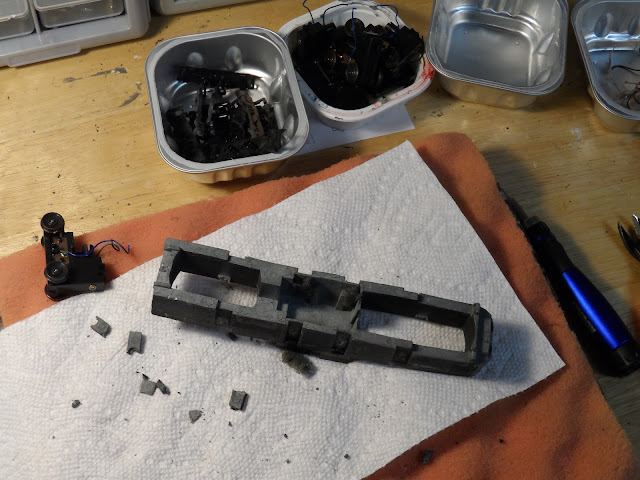
Some of the Walthers units continue to show signs of zinc rot twenty years after their original purchase. This is what zinc rot or zinc pest looks like.
Attempts to grind down the frames to fit under their respective shells was a waste of time. There is no cure for this other than scrapping the chassis.
As of this writing two new Walthers FB units have been purchased via ebay for Lehigh Valley and Empire Belt empty shells.
Shell swapping on these units is hindered by the difficulties in prying their shells off the power chassis. The shells lock onto the chassis with large tabs and it is a pain in the buttocks getting the shells off.
Although the models have had their share of operating issues I still enjoy having them on my roster and continue to do my best to keep them in service.
Enjoy the New York Central Alco F series and friends in action.
Welcome to the first Shop Service Bulletin of 2022. Hopefully you will find this helpful.
Locomotive Service Bulletin 2022 Number 1
From: Terminal Yard Engine Shop
To: All Locomotive Shops
Subject: Bachmann Plus Locomotive Power Truck Issues
1.Routine servicing of Bachmann Plus EMD F7A and F7B locomotives revealed that the power trucks on several units were not transferring power from the wheels to the motor.
2.Causation has been determined to be the ground side power strap not properly grounding the locomotive due to the chemical black applied at the factory. This power truck is from an H16-44 and is similar to the F7.
To restore power from the truck to the motor pry off the truck side frame at the front or rear of the truck. Remove power strap by loosening small Phillips head screw and lightly sand off the black coating where it contacts the wheels and locomotive frame. Lightly sand the frame where the power strap makes contact.
Welcome to the first post in the freight car spotlight series. These posts will focus on models used on the layout and include prototype info if applicable.
Today we'll take a look at the Walthers Trainline 40' Gulf Tank Car #931-1612. These cars were part of my prior HazMat Regulations blog post.
The Model
The Gulf tank car data is clearly legible with my reading glasses. It has a 100,000 pound capacity, a light weight of 43,200 pounds features metal wheels and body mounted knuckle couplers The reporting marks for the car are WRMX 14285, build date of 3-50.
The car does not come with HazMat placards and I'll be adding Highball Graphics 1993 placards, Class 3 Flammable Fuel Oil, from HazMat decals set AD-13
The new Gulf tank car and two others used in the Penn Central Car Movements virtual operations have their Class 3 1993 placard decals applied. An overspray Testor's Dullcote was used to protect the decals and dull the cars bright finish. All cars received Kadee #5 couplers and had their wheel faces painted flat black.
The three Gulf tank cars make a nice looking block for movements in the virtual ops. Using prototype tank car photos each car received four placards, one on each end and one on each side.
The Gulf tank cars loaded with Diesel Fuel Oil for the Long Island RR Morris Park engine terminal are properly placed within this test train that simulates a transfer run from Terminal Yard to North Side Yard in Empire City for interchange with the LIRR.
Additional Comments
Out of the box the tank cars are very lightly weighted. Adding additional weight would be preferable but taking the model apart to do so looks daunting as it is glued together.
Prototype Information
WRMX reporting marks are unassigned. RR picture archives reports an idler car to have them but it is not visible. Interestingly WRNX belong to the Gulf Oil Company and Chevron USA Inc which purchased Gulf in 1984.
A google search for Gulf Tank Car revealed this old photo of a Gulf tank car that is close to the model.
Couplers
Type E or F? Since I am using the cars in the late 1960s and very early 1970s operations I think the type E coupler, like the Kadee #5s are OK. This is close call as it appears the Type F couplers became mandatory in 1975. Modelers running more modern operations may choose the now mandatory Type F couplers like the Kadee #119 used on tank cars.
Final thoughts
The Gulf tank car model is very close to the old photo of the Gulf tank car in the link above. The reporting marks may or may not have been assigned to Gulf Oil. All in all I find it to be a good looking model that works very well in our prototypical operations.