
Greetings All,
Adding a Mi-Jack Trans-Lift Intermodal Crane
In order to prepare for an expected increase in Intermodal Service a Mi-Jack trans-lift intermodal crane kit was purchased to expedite the loading and unloading of containers and trailers from road freight to railcars.

Background
The late 50's and 60's were a time of innovation and change for intermodal operations but loading and unloading trailers remained a constant headache. Terminal were equipped with huge ramps, some several tracks wide, where trucks backed onto flatcars to drop or retrieve trailers. This was known as "circus loading" as it resembled methods used years before to load circus wagons.
Once the flatcars were spotted there could still be problems such as missing bridge plates, stuck hitches, hitches needing to be powered or raised and more. Another issue was that all the flatcars had to face the same way and time was often lost switching cars. A trailer carrying a "hot load" (such as mail or food) could be several cars deep and had to wait until all of the trailers ahead of it were removed.
To alleviate these problems the New York Central developed the "Flexi-Van" system in which containers swiveled onto special flatcars. Mechanical problems and shortages of wheel/axle bogies along with high maintenance costs and low availability of auxiliary equipment made this system undesirable.

Prototype Information
What's a Mi-Jack Trans-lift Intermodal Crane?
Another solution for the existing intermodal inefficiencies was a self propelled crane developed from a boat lifting design. Drott Manufacturing teamed up Mi-Jack Products to build these early units.
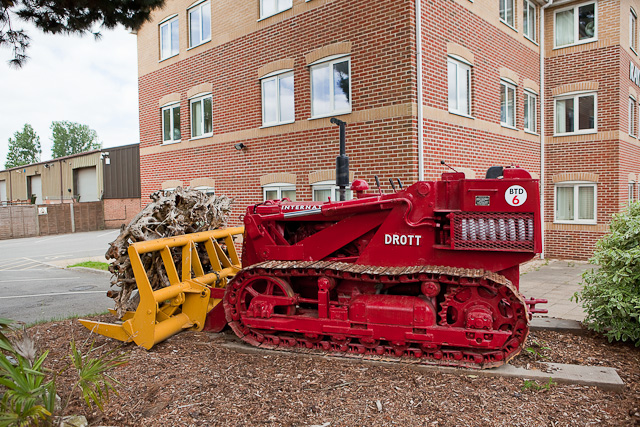
In the 1960's Jack Lanigan Sr. joined with Drott to spearhead the use of these cranes for railroad duty. The units were tested on the ATSF for containers used by shipping lines but these containers required special equipment to lift them on and off their highway chassis. Some railroads simply handled them as trailers leaving them on the chassis for shipment by rail.

The Drott crane tests caught the attention of the Union Pacific and Southern Pacific railroads. Based on data from the test models Drott Manufacturing and Mi-Jack Products improved the design with a reliable stabilizing beam to eliminate swaying problems.

Unit #1 was delivered to the ATSF in 1963 and assigned to Corwith Yard near Chicago. A second unit was ordered for Hobart Yard near Los Angeles which was delivered in 1965. At this time the ATSF began to develop their container business which required the capability to lift containers from the top or bottom. Mister Lanigan solved this problem by developing a slide latch which used the existing holes on tops of the containers, originally intended for grappling hooks.

Jack Lanigan Sr. established Mi-Jack Products in 1955 and became a dealership to sell the Drott cranes to the railroads during the 1960s.

"Mi-Jack Boom Crane" by Anntholley is licensed under CC BY-SA 4.0.
J.I. Case acquired Drott Crane in 1970 but decided to drop the line in 1980. At that time Lanigan made the move from dealer to manufacturer purchasing the patents, drawings, parts and inventory from Case and set out to redesign the machines.

Eventually these cranes became the Trans-lift Crane a dual purpose machine ideally suited to the modern mix of trailer and containers traveling by rail. Trans-lift Cranes have proven themselves over time with a 99% availability and handling up to 100,000 lifts per crane per year depending on traffic density.

Model Information
The Walthers Mi-Jack Trans-lift Intermodal Crane is part of their Cornerstone Series sold under item #933-3122. The kit parts come molded in orange, a decal sheet for several railroads with Mi-Jack lettering.


The big blue 30 ton crane now displaced returned to its original home in Empire City.


The Mi-Jack crane provides the muscle to keep the intermodal traffic moving to meet its tight schedules and ensure profits. The Mi-Jack with the right operator can complete a lift and place cycle in less than one minute. That is very impressive!!


TOFC/COFC Videos
Here's a good look at some TOFC highlights on the layout circa 2022An HO Scale shout out to the Penn Central 1973 Award Winning TOFC Program from July, 2023.
Tales From The Ramp
During 2010 I worked as a CSX Intermodal Worker in both Hulsey Yard in Atlanta which did not have the room in the yard for Mi-Jacks and the Fairbairn, GA dedicated intermodal yard or ramp as it was known from the old RR terminology which did. I was fortunate to work with some really good guys and crane operators. Two who stand out among the cast of characters were Danny, nickname "Alabama" and "Hollywood".

These guys were amazing with the Mi-Jacks. They could swoop a container right onto the front pins of the chassis without missing one all day. Of course this was against the rules but it saved a lot of time and was mostly overlooked when it suited the company. If the operator missed it could cause damage to the neck of the chassis. When the crew pulled together it was a sight to behold.

One of my duties was to drive a yard tractor to deliver or remove trailers from the ramp adjacent the railcars. During the unloading cycle the crane operator would call for chassis depending on the containers as the chassis were either part of a pool or owned by a company like JB Hunt. Digging out the right chassis could be an adventure at times.

"20030531 09 BNSF Cicero Intermodal Terminal" by davidwilson1949 is licensed under CC BY 2.0.
The other job I held frequently was the "grounds man" who climbed the cars to unlock the inter box connectors that held the top container in place. Once we cleaned the top I started back in the opposite direction and pulled the IBCs from the bottom container securing them in the holders welded into the railcars. I liked this job as it was good exercise and most people didn't want it.
During this time CSX and UP created UMAX container service.

"2/2 NS 8104 Leads EB Intermodal in KCMO 7-20-19" by KansasScanner is licensed under CC BY 2.0.
Another thing I learned was that the CSX Fairbairn Yard/Ramp did the intermodal lifts for BNSF during my tenure and you could always rely on at least one if not two huge BNSF trains with containers on the head end and trailers on the rear arriving right after lunch time on a Saturday afternoon. Hello, forced overtime... I hated the BNSF!!!

However I did get to see one of the Super Fleet Warbonnets which was very cool.

The accolades afforded to the Mi-Jacks in this article are 100% accurate from where I witnessed them in action day after day up close and personal.
Final Thoughts and Comments
For whatever reason this kit ate me up and spat me out. If you've ever tried building a model kit and wanted to throw it against the wall this was that kit. The instructions were hard to follow. I put together as many sub assemblies as possible for painting and adding decals. This exacerbated the build process as parts continually broke off whether attached prior to painting with Bondene or post painting with CA.
The kit is designed to have an adjustable trolley to go side to side and expand to handle 20' and larger containers. Note: All containers 40' and longer have their pick up holes at 40' which is an industry standard. The kit also came with four adjustable grappler arms to lift trailers. Fuhgeddaboudit!! The pins holding them in broke off at the first attempt to do this!!! As the Mi-Jack sits today on the layout it can roll freely but cannot do any of the functions listed in the instructions.
Additional Information
Much of the above information was provided in the Walthers kit and credits Jack Lanigan, Sr. and Trish Vesely of Mi-Jack Products.
Thanks for reading and watching!!!
See you soon!!!


