
Greetings All,
Welcome back to the New York Central Systemin Transition
Today we'll take a look at some of the NYC's first generation motive power that continued to serve the railroad and some of the second generation motive power purchases that would deliver the freight over the road to the future.
Background
In 1954 one of President Perlman's first cost cutting measure to bring the railroad to profitability was to cut diesel orders in half, claiming that more mileage could be squeezed out of the existing fleet. This logic was based on the Santa Fe's diesel utilization however the NYC and ATSF were two different animals. Santa Fe's long haul trains of up to two thousand miles at a crack naturally made better use of its diesel locomotives.

The Central's operations consisted of much shorter line haul runs that were unavoidably less efficient. By the time President Perlman realized the flaw in his logic nearly all of the available new locomotive production had been allocated to other railroads deep in the throes of dieselization.

"AT&SF EMD F7 42C" by Digital Rail Artist is marked with CC0 1.0.
By the end of 1955 service on the Central had slipped considerably with trains sitting in yards waiting for available locomotives to haul them.

A nationwide recession in 1957 caused a serious drop in freight traffic. This, combined with the New York Central decision to scale back passenger traffic left the railroad with sufficient motive power for several years with surplus passenger locomotives bumped to freight service and older locomotives retired.
In the early 1960s the NYC began acquiring new high horsepower locomotives, first from EMD, then Alco and then General Electric.
Passenger Train Power
The EMD E7As and Bs along with the EMD E8As continued to handle the bulk of the remaining passenger car assignments with surplus units being assigned to Flexi-Van trains at times.

The Alco PA1 and PB1 fleet was being retired at this time with the PA2s hanging on until their leases expired.

Yard Power / End Cab Switchers
EMD NW & SW
The NYC rostered a large group of EMD end cab switch engines to handle various chores around the system. In total there were 472 units broken down as follows: SW1 - 101, SW8 - 28, SW900 - 19, NW2 - 150, SW7 - 87, SW8 - 87. Below are a pair of SW8s assigned to Terminal Yard.

Alco Switch Engines
Alco S4 8598, shown in Terminal Yard wearing only the utilitarian pre merger "Road to the Future" herald is one of 166 Alco end cab switchers on the NYC roster. The 8598 was delivered to the Central in 1952.


Baldwin S12
The Central employed a group of 21 Baldwin S12s. The Eddystone built switch engines were very powerful and made it to the Penn Central roster after being renumbered into the 8000 series. The 9314 arrived on the Central in the summer of 1952.

Road Switchers
Alco RS1
The Alco RS1 was considered the first successful road switcher and the NYC added 14 such units to the roster. The 9909 was delivered to the NYC as their #8109 in 1950.

Below RS1 9909 and RS32 8040 await their next call to duty at the engine terminal.

Alco RS2
23 New York Central Alco RS2s delivered in late 1949 and early 1950 (8200-8222) would mostly be retired by 1968. Six were listed as active on the roster at the time of the merger with all retired by 1969.

Alco RS3
Alco delivered 130 RS3s (8223-8352) between 1950 and 1953 to the NYC. The RS3s were tough locomotives that were able to handle daily abuse and come back for more endearing them to the NYC and other railroads to the tune of more than 1,300 built.
Ex NYC RS3 #8253 still hard at work in this October 1976 photo as Amtrak #125. This is a very cool photo!!!

Later in their post NYC lives some RS3s were rehabilitated with surplus EMD E unit prime movers and equipment and become classed as RS3ms. The rebuilt engines would also gain the nickname "Dewitt Geeps" for the shop that did much of the work.
EMD FTA-FTB
The pioneering New York Central FT A-B-B-A consists that were connected via drawbars were broken up to form A-B sets to be used in A-B-A consists with another locomotive like the F7A-FTB-FTA lash up below.


EMD F7A-F7B
The F7A-F7B fleet continued to provide good service in their cigar band scheme right up to and thru the merger with the Pennsylvania RR.


Alco FA1-FB1-FA2-FB2
The NYC had the largest Alco FA-FB fleet with the purchase of the FA1-FB1 and FA2-FB2 models. In the 1960s the NYC FA1s began to be retired and used as trade in fodder for new GE locomotives.

Baldwin RF16s
The Baldwin Sharks continued in service mostly on the western end of the system until just before the merger with the Pennsylvania RR. Equipped with an air throttle the Sharks could only M.U. with themselves. These locomotives had a reputation for pulling everything including the yard office but not over 45 mph. The Sharks would find a second home in revenue service for coal hauler Monongahela Railway.

Fairbanks-Morse Erie Builts and C-Liners
The NYC rostered a small group of the opposed piston powered A-1-A axled Erie Builts and all three models of the FM C-liners. In fact the Central was FMs best customer. Some of the Eries and C-Liners would be repowered with EMD prime movers and work into the 1960s.

EMD GP20
The New York Central entered the turbo charged locomotive market in 1961 with its purchase of fifteen GP20s. The GP20s were also the first low hood road switchers on the roster and the only GP20s erected without dynamic brakes.

EMD GP7 and GP9
The very popular EMD GP7 and GP9 series locomotives served the New York Central very well in a variety of assignments. The Central purchased 228 GP7s and 176 GP9s. Below GP7 5694 was part of a small group with dynamic brakes for coal train service.

Alco RS32
In 1961 the NYC started to replace their older Alco power with a newer group of 2,000 HP RS32s. Using trade in material from the FA1s and PA1s fifteen RS32s arrived in 1961. Ten more followed in 1962.

EMD GP30
New York Central made a small purchase of GP30s in 1962. Similar to the GP20s, the ten units were built without dynamic brakes.

EMD GP35
The Central continued purchasing EMD products adding thirty GP35s in 1963 and the World's Fair Demonstrator in 1965. Below the demo is now NYC 2399 and the only GP35 on the roster with dynamic brakes.

General Electric Universal Series
U25B
The Central tried and liked General Electrics first domestic diesel product. In a two year span the Central ordered seventy U25Bs.
U28B
NYC purchased twenty two U28Bs in early 1966 that were erected with the U25B car body design for subsidiary Pittsburgh & Lake Erie.

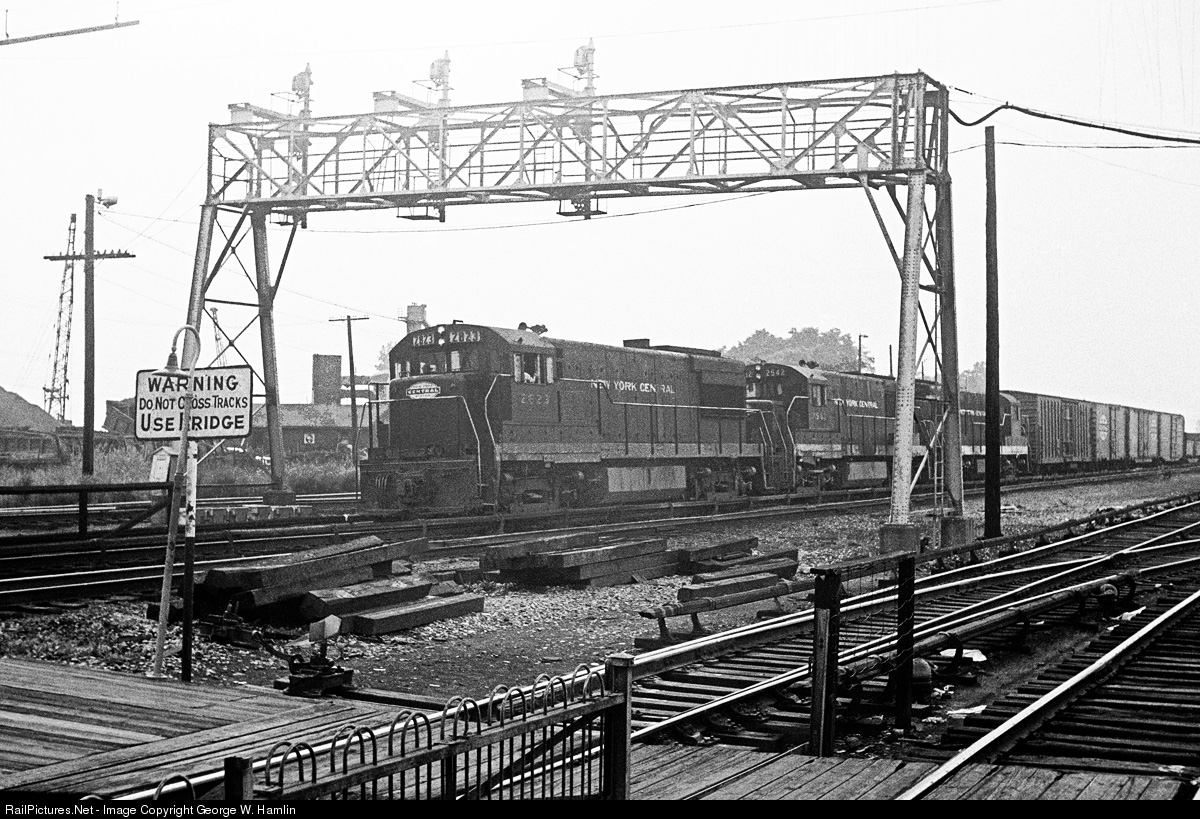
In May, 1966 two U28Bs (2822-2823)were delivered to the NYC on the new frame. Both the 2822 & 2823 would become prime power for the newly created Penn Central.


U30B
Between 1966 and 1967 sixty U30Bs were delivered with only "The Road to the Future" herald and road number as requested by the NYC and PRR planners for easier repainting for the merger that would take place in 1968. I don't like that scheme so I added some New York Central lettering to the long hood of these Athearn BB models.

EMD GP40
In 1965 the NYC ordered 105 EMD GP40s, the first such models built, with dynamic brakes that had not been a very common Central locomotive option during the second round of diesel purchases. Below is ex NYC / PC GP40 #3087. "10/18/78, Conrail GP40 3087" by OHFalcon72 is licensed under CC BY-NC-ND 2.0.
Here is a GP38 pretending to be part of later group of GP40s that were delivered with just a herald and road number.

Last But Not Least
Alco C430
In late 1967 Alco delivered the final New York Central locomotives, ten Alco C430s #2050-2059 making the 2059 the last NYC new locomotive. Here is a 1:87 scale Tyco rendition of ex NYC C430 #2059 that I painted and decaled.

New York Central 1960s Motive Power in Action
Here are some of the second generation NYC locomotives in the fleet getting the spotlight.Final Thoughts and Comments
Thank you to all who have followed along with this three post NYC mini documentary. The project started as a simple look at the 1:1 scale New York Central of the 1960s with my 1:87 scale rolling stock and locomotives presenting the story. As we can see that didn't happen!!
NYC Locomotive Consists 1966-1967
The Canada Southern website offers a look at the NYC trains and their locomotive consists from Syracuse, NY during July, 1966 and Rochester, NY during November, 1967. I found this quite interesting from a modeling standpoint. You can see it here.
The 1960s were a tumultuous time for the railroads trying to compete with subsidized air and highway travel that drained the coffers of the NE railroads whose short runs were prime picking for trucking companies using the new subsidized interstate highways and airlines using subsidized airports. Archaic Inter City Commerce Commission rules and tariff regulations had the railroads basically fighting for their lives with one hand behind their backs.
On February 1st, 1968 the once great and proud New York Central became a fallen flag when it was merged into the Pennsylvania Railroad to create the Penn Central Transportation Company. We all know how that ended.
References and Resources
Canada Southern Website.
New York Central Color History by Brian Solomon with Mike Schafer.
New York Central Lightning Stripes Parts 1 and 2 by David R. Sweetland.
New York Central's Great Steel Fleet 1948-1967 by Geoffrey H. Doughty.
Penn Central Bi-Annual by Robert H. Reid
Thank you very much for reading and watching!!!
See you soon!!!
An excellent third installment to your NYC history! You have a remarkable roster of locomotives! Mr. Pearlman would have been envious! I hadn't known about his attempt at cost cutting in 1954 that led to a motive power shortage on the Central! Thanks for the review of the various models of locomotive purchased by the road. You did a great job painting and decaling so many of your 1/87th scale versions!
ReplyDeleteThank you very much Ralph!! This was a fun endeavor (for the most part) and am happy you enjoyed it.
Delete