New York Central Alcos

New York Central Alcos
NYC RS32 #2040 leads a trio of R32s hauling Train NY-4

Friday, November 16, 2018

Intermodal Ops Primer #2

Greetings All,

Tomorrow's the Intermodal Ops#1 dispatch date and the guys are getting ready. 1:1 Sir Neal has his Atlantic Pacific RR ready to go!
John Bruce has the Los Feliz & North Western all set to go!


The N.Y.C.T.L. is getting ready as I pull out, organize and tune up my small fleet of double stack cars. Let's take a look at the cars and some loading tips for better realism.  

A five platform set of Athearn BB Gunderson Maxi III cars is considered one car as each element is dependant on the other. Each unit has a letter designation. The A and B cars are the end cars and both are coupler equipped. The intermediate cars are the C, D and E cars. The proper configuration for the set is A-E-D-C-B.  
A 40' container rides on top of two 20' containers and a 48' container rides on top of a 40' container. Any length container between 40' and 53' would be appropriate as the top container. 
A pair of 20' tank containers loaded with their control valves facing outward. The 20' containers have sufficient clearance for the valves in the 48' well. They are not be loaded into a 40' well. 
No double stacking for this car! This is a no-no.
20' containers should be loaded with their doors facing each other to prevent theft. One thing to know about shipping containers is that the 40', 45', 48' and 53' containers all have their support structure at the 40' length and 96'' width. This industry standard allows for the stacking of the containers for transport.
When loading 20' containers in the well be cognizant of the height differences between container types. The standard containers are 8'6'' and the Hi Cubes are 9'6'' in height.  
 You definitely don't want this! 
No 20' containers on top! You can really see the height difference between the 20' containers now. 
And no single 20' containers riding alone.
This looks cool but it's a no go. Also note the width difference between the 96'' wide 40' container and the 102'' wide 48' container. 
A loaded five car all purpose well car set would look like this using both containers and trailers. The trailers are in the E and C cars. The all purpose cars are equipped with trailer hitches in each car. 
Terminal Yard looking a bit different today! A look at most of the intermodal cars in my fleet getting ready to be loaded. The unlettered Maxi III cars on the right are a project 10 years in the making. 
Let's take a look at some scene setting for a layout. This is for illustration purposes only. Three trailers are prepositioned for lifting onto the Impack cars. Blue flag protection is in place and the switch to this track is locked closed.
Trailers are spotted adjacent their designated car for ease of loading. This is fine for both a side loader or overhead lift.   
A five car set properly loaded with three trailers. 
Loading containers is a bit different with the handling of the chassis that is left behind. When using an overhead lift like a MiJack the containers can be prepositioned. If using a side loader then the chassis must be pulled away once the container is lifted so the side loader can access the well car.
If staging such a scene on your layout the larger containers can face either direction. 
 The 20' containers should be back to back.
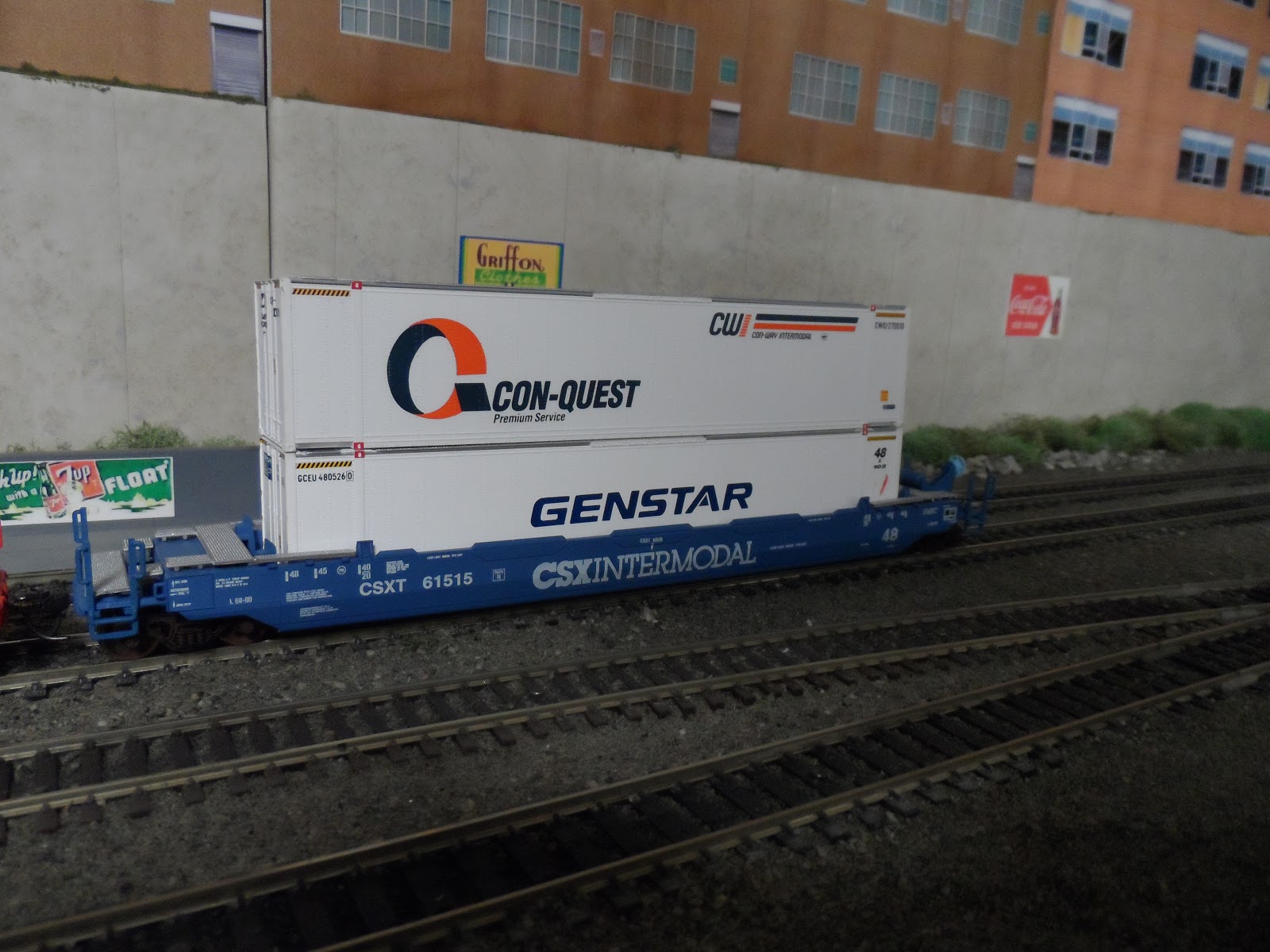
Here is a single Athearn BB CSX Intermodal Maxi III car loaded with 48' containers. Note the red marks on the containers. They are 40' apart and 96'' across. This where the cars connect using an Inter Box Connector or IBC. 
And there it is, everything you wanted to know about the N.Y.C.T.L.'s intermodal fleet but were afraid to ask! 


Tomorrow we launch the first Intermodal Op!

Thanks for reading!

Thursday, November 15, 2018

Intermodal Ops Primer Part 1

Greetings All,

Good news to report! The P.C.C.M. gang are going to run an Intermodal Virtual Op starting on Saturday November 17th. This newest virtual op was inspired by John B when he posted an aha moment relative to his double stack container trains.

Before Intermodal became an industry buzzword this type of traffic was commonly referred to Trailer on Flatcar (T.O.F.C.), Container of Flatcar (C.O.F.C.) and the ever popular Piggyback.

Let's explore some of the intermodal traffic that the N.Y.C.T.L. is capable of running. 

B&O TOFCEE SERVICE was a marketing play on T.O.F.C. launched in 1954 using 41' and 53' flats. In the early stages of T.O.F.C. the trailers were shorter and so were the flatcars in use.
As trailers got longer single trailers were mounted on flatcars instead of the two shorter ones. This piggyback setup is common for the P.C.C.M. T.O.F.C. traffic between my layout and Ralph's K.P.D. layout. Remember when using a piggyback ramp all trailers need to face the ramp for loading and unloading.
In 1958 New York Central launched its Flexi-Van system and the containers began appearing on certain fast freights and in dedicated service between New York and Chicago in 1960. 
By 1965 Flexi-Vans generated 15 percent of Central's profits using only .05 percent of its equipment. The U.S.P.S. was a big proponent of the Flexi-Vans
The Pennsylvania Railroad launched their TrucTrain Service in July 1954 using 50' flatcars (class F30D) and leasing the first 200 75' T.O.F.C. flats (class F39) capable of hauling two 35' trailers. 
On November 9, 1955 Trailer-Train company is formed with three owners, Pennsylvania RR,  Norfolk & Western RR (partially owned by PRR) and Rail Trailer Corporation. The name Trailer Train was chosen from 6,000 entries in a PRR employee naming contest.
In 1958 85' flat cars equipped with trailer hitches became state of the art equipment. Without the hitches the securing of trailers was labor intensive and time consuming.
In 1958 Railway Express Agency uses New Haven RR's T.O.F.C. service between Boston and New York City. In 1959 REA would use the PRR T.O.F.C. service between Philadelphia and Chicago.
In 1956 Malcolm McLean founds Sea Land and begins using standardized containers for maritime shipping. In 1972 the Penn Central and A.T.S.F. would launch a coast to coast Rail Bridge Service moving Sea Land and Sea Train containers between ships in Port Newark NJ to ships either at Los Angeles or Oakland CA. Streator IL was the RR transfer point. Run thru power was common. This cheapie AHM car wasn't far off the mark!   
Much to their chagrin the New York Central started to convert some of their Flexi-Van cars for T.O.F.C. use. I read a humorous story about testing the first cars without taking into consideration the passenger platforms the train would be passing. The cars made it with no damage much to everyone's relief.
Not long after the Flexi-Vans were gone from railroading articulated spine cars to handle T.O.F.C. came into being courtesy of the Santa Fe.
In 1978 A.T.S.F. designed and built the 10 Pack Fuel Foiler set designed for 40' and 45' trailers and to run strictly on the A.T.S.F. as they were not designed for interchange service. 
In 1981 ITEL (FMC Gunderson) bought the design from A.T.S.F. and dubbed them IMPACK for InterModal PACKage. ITEL sold the cars in various 3, 4, 5, 8 and 10 car configurations. The orange cars in the foreground are ITEL IMPACK cars
In 1988 the All-Purpose Spine Car was designed to handle 48' trailers / containers. The two end units could carry a 40' or 48' trailer / container or 2 20' containers. Bethlem, Gunderson, Trinity and Thrall were the builders. Below is a five car set from Walthers with 2 20'ers, a 48'er and a 40'er. 
With container traffic continuing to grow the single container per car was not cutting it. In 1977 the Southern Pacific along with Malcolm McLean (of Sea Land) devised the first double stack intermodal well car. None other than John B himself has a set of the early SP cars! See more of them here

In 1984 American President Lines works with Thrall to develop a refined well car and the Union Pacific RR to operate a train service using the new well cars. In 1984 the first double stack train left Los Angeles for Kearny NJ under the name Stack Train Rail Service. 
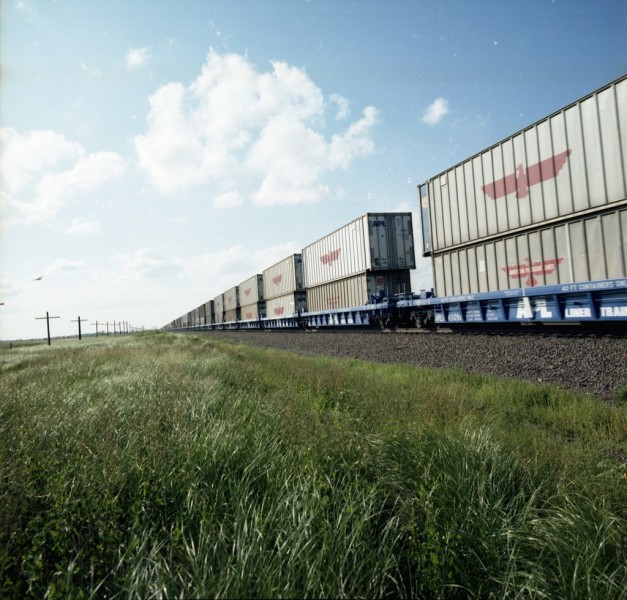
An example of a double-stack train.
On the NYCTL my double stack fleet consists of Gunderson cars like this Athearn BB five car set. 
And a pair of single Athearn BB cars.
Tomorrow we'll take a look at loading these cars and some of the intermodal traffic I'll be running with some tips on how to maximize their realism.

Be sure to check out John's B's Getting Ready For Intermodal Virtual Ops blog post!


Thanks for reading!!!

Tuesday, November 13, 2018

P.C.C.M. 52C

Greetings All,

Welcome Back to P.C.C.M. 52!!

Today we'll catch the L.I.R.R. delivering fourteen gondolas loaded with scrap steel from Gershow Recycling to the Empire Belt's Northside Yard. The E.B.R.R. will get the gons over to the Penn Central's Terminal Yard where the gons will be dispatched to Selkirk for forwarding to Kings Port Steel on Ralph's Kings Port Division layout.

Two ALco RS units power today's L.I.R.R. transfer freight thru Bedford NY as it makes its way to North Side Yard.
L.I.R.R. caboose #12 bringing up the markers as the train passes thru Bedford Station.
The L.I.R.R. train is on the Empire City viaduct as it approaches Hohman Ave
The L.I.R.R. train arrives at North Side Yard where we catch the guys in deep discussion. The topic, if 1/87th scale PC Ralph is at the throttle of the E.B.R.R. U Boats should he be called Captain Ralph? I'll let you guys decide! Meanwhile conductor John double checks the lock on that good looking 40' reefer of Schaefer Beer.
The L.I.R.R. heads back towards Long Island with few trainloads of beer among the other freight cars. Long Islanders will be able to enjoy more than one Schaefer beer tonight courtesy of 1:1 Sir Neal who sent that Schaefer 40' reefer my way. Thanks Sir Neal! 
A little later 1/87th scale PC Ralph couples up to the gons left by the L.I.R.R. for the run over to Terminal Yard as Train EB-2
EB-2 heads out thru the west side passing Hohman Ave
Rolling thru Bedford NY PC Ralph spots that familiar VW being chased out of Empire City. 
EB-2 arrives at Terminal Yard with fourteen gons of scrap badly need to quench the thirst of Kings Port Steels Basic Oxygen Furnace.
PC Ralph checks in at the Terminal Yard office and sees that familiar VW again.   
 The E.B.R.R. leaves Terminal Yard caboose lite.
The yard job gets to work on the newly arrived gons. Apparently this trainload of scrap steel has become a high priority and will be leaving Terminal Yard as an Extra very shortly.
The power has been called out from the engine terminal. 1/87th scale Big Mike is guarding the crossing and giving the driver of the VW an earful about the GP30s slippage issues. 
 A short time later Extra 2232 leaves Terminal Yard
 Extra 2232 comes around the curve at T&R Gravel
Caboose 18423 brings up the markers on Extra 2232.
Meanwhile that VW is now getting chased out of Brooklyn! 
Extra 2232 crossing the High Line
 Extra 2232 crosses the EC viaduct. Next stop Selkirk!!
The loaded gons are going, going, gone goodbye! to quote the late great Ralph Kiner! Be sure to follow up the action on Ralph's K.P.D. layout!! 


Thanks for reading!!