New York Central Alcos

New York Central Alcos
NYC RS32 #2040 leads a trio of R32s hauling Train NY-4

Saturday, August 15, 2026

Introducing New York - New Jersey Express TOFC Service

 Greetings All,
Introducing 
New York - New Jersey Express
TOFC Service

Well here we are after two weeks of Intermodal Equipment building projects and it's time to introduce the reason. A couple of months ago 1:1 Sir Neal floated the idea of a high speed TOFC service from the never seen in the virtual ops Atlantic Pacific Railroad Intermodal Terminal to the Terminal Yard Intermodal Ramp. 

That caught my interest and as we explored the possibilities Sir Neal pulled the ace from up his sleeve, "I have ten UPS 40' trailers and eight UPS 24' containers on chassis(basically trailers) that we can use for the project. Further discussions led to branding this service as New York - New Jersey Express. With that agreed upon Sir Neal ordered the appropriate decals and shipped the whole shebang to me in a large box.

The Patti-O Paint Shop took up challenge and delivered the eighteen trailers on time and under budget.
Backstory
A recent meeting of the top staff from the Atlantic Pacific, the Penn Central, the Empire Belt Railroads with shippers and consignees from the New York, New Jersey, Connecticut, and Pennsylvania Quad-State area was recently held to address several matters pertinent to the interchange of NY-NJ freight traffic.

One of the topics brought up was Less Than Carload (LCL) traffic that had been lost to the trucking industry and how to win it back by providing a profitable high speed Intermodal Service that would carry 24' containers on chassis(TOFC) and standard 40' trailers. 
"8/1/78, Conrail GP38-2 8110" by OHFalcon72 is licensed under CC BY-NC-ND 2.0.
Several discussions were held on how to best route these trains to assure that customers would be satisfied with the service and willing to pay the premium prices for this service. 
"Trailer On Flat Car, Florida East Coast" by Gary Lee Todd, Ph.D. is marked with CC0 1.0.
The car route from Allentown, Pennsylvania to Rock Ridge, New Jersey to Terminal Yard in East Bedford, NY isn't Chicago to Los Angeles ATSF Super C train but anyone who has tried to drive from Allentown, PA to Long Island, NY can attest to the clogged roadways, poor road conditions, bumper to bumper traffic and numerous tolls which hampers the trucking industries efficiencies.
"New Jersey traffic jam" by wseltzer is licensed under CC BY 2.0.
The proposed NY-NJ Express TOFC Service would seek to overtake the trucking industry by offering loading dock to loading dock service with trains that wouldn't be negatively affected by weather. The schedule would for trains departing Rock Ridge Yard or Terminal Yard Monday thru Friday at 7:00 PM with the trailers delivered to their consignees by 7:00 AM the following morning.
"2/15/78, CS GP40 3790" by OHFalcon72 is licensed under CC BY-NC-ND 2.0.
Adding New Equipment
To get started with this new and hopefully profitable rail service 40' and 24' trailers were purchased from United Parcel Service by the Atlantic Pacific Railroad and sent to the Patti-O Paint Shop for repainting and branding.

24' containers on chassis will become part of the NY-NJ Express trailer fleet. Some shippers of LCL merchandise favored this size of container / trailer which could also be driven as a double trailer with a bogey connecting the two. Trust me it's like driving a slinky!!!
Standard 40' trailers were also purchased to meet the shipper's needs. Here is a group of ten awaiting new paint and lettering.
New decals were purchased by the APRR to give the service its own branding.
A Mi Jack Trans-lift Intermodal Crane was purchased by the Penn Central for Terminal Yard. Link to this blogpost below.
A Kalmar Crane was also purchased as back up and to speed the loading and unloading of container traffic on the ramp as necessary. Link to this blogpost below.
The NY-NJ Express Trailers
Go Thru The Patti-O Paint Shop
The first of the eight NY-NJ Trailers (24' containers on chassis) have been released by the Patti-O Paint Shop. The APRU containers wear the APRR corporate orange paint scheme 
The EBRU trailers wear a shade of green to be consistent with the corporate colors of the EBRR and parent PC.
A newly purchased ex-UPS trailer has been lifted from its flatcar and moves towards the Patti-O Paint Shop.
The NY-NJ Express trailers feature the heralds of both the APRR and EBRR. The 40' trailers will receive EBRZ reporting marks as seen below or APRZ reporting marks depending on corporate ownership for tax purposes.
The decals have been added and the trailers are in the decal setting solution phase. The eight trailers sitting vertical have just had their reporting marks and road number added to the rear doors.
The new Mi-Jack is ready to load the 24'ers onto a 75' TOFC flatcar.
Assigned Motive Power
The lip service provided to the shippers promising a new fast freight TOFC service means nothing if the railroads concerned cannot supply the necessary motive power to get these trains over the road.

To convey the run thru stature of these trains traveling between Rock Ridge Yard and Terminal Yard PC locomotives that Sir Neal and I have in common will be prime candidates as the Penn Central has agreed to contribute second generation GE or EMD locomotives to this service like these U25Bs.
Load them Up!!!
The new trailers get their first loads at Moore & Company in Empire City.   
Over at the Quaker Oats Plant in the Haydon Heights neighborhood of Empire City a 24' and 40' trailer take on loads.
An NY-NJ Express trifecta at Key Food in Bedford NY. A PC tractor pulls a loaded 40' trailer, a 24' EBRU trailer takes on freight as a NY-NJ trailer heads to the Terminal Yard ramp behind a yellow tractor operated by a contract driver.
It's getting late in the afternoon and the cut off time has approached. A pair of GP7s couple up the the first NY-NJ Express train on the Terminal Yard ramp.
The distinctive New York New - Jersey Express trailers are loaded for their first revenue run.
The Empire Belt 40' trailer with a hot load going to Rock Ridge Yard was added to the train with a waybill including this premium service charge.
The 24' trailers (containers running on chassis) bring up the rear of the train.
The terminal switcher tacks on PC caboose 26043.
It's time to go!!! Sir Neal watches the train get pulled from the ramp as conductor John checks his watch to make sure we are running on time.
A good look at four of the ten new NY-NJ Express trailers.
Seven of the nine New York New Jersey Express trailers remaining at Terminal Yard are lensed near the ramp as they await movement to their next loads or onto the next NYNJ-1 Train.
New York New Jersey Express Train NYNJ-1 departs Terminal Yard for Rock Ridge Yard behind PC U25B 2568. The counter part Rock Ridge-Terminal Yard train will be symbolled Train NJNY-2.
Next Stop Rock Ridge Yard!!!
Not so Far Fetched
Short haul premium TOFC trains have been tried by several railroads that come to mind with mixed success. The Penn Central instituted a TV (TrailVan) train between Harrisburg, PA and Buffalo, NY which wasn't successful and was removed from service.

A bright light was the Boston & Maine - Central Vermont formation of the combined "The Rocket" piggyback service in the early 1980s which ran from Montreal, Canada to New Haven, CT. 
"bm 309 at binghamton" by Slideshow Bruce is licensed under CC BY-NC 2.0.

In the Classic Train Winter 2025 magazine author Brooks A. Bentz does a great job detailing how two downward spiraling NE railroads used aggressive marketing, the freedoms of the Staggers Act and concessions from the railroad unions to run these trains with a two man crew and no caboose. Negotiations led to an agreement to run 15 car trains with no caboose and two crew members.
"Central Vermont Railroad" by Harfang is licensed under CC BY-SA 3.0.

Mr. Bentz was at the forefront of this as general manager intermodal services for the B&M. He also founded motor carrier BMX, for Boston & Maine Express. Sounds a bit familiar...

The initial foray into the short haul intermodal business was dreadful with loadings of only a single trailer at times. As a result the BM-CV trains cut a deal with Conrail called "Cooperative Competition" which enabled the B&M to route traffic on Conrail's high-speed dedicated TV Trains from the west end of the B&M at Rotterdam Junction, NY to and from Chicago, St. Louis and points west on the Santa Fe via Streator, Illinois. 
"trackside building and TV train" by Slideshow Bruce is licensed under CC BY 2.0.

Final Thoughts & Comments (Finally!!)
First and foremost kudos to Sir Neal for originating the idea of this dedicated high priority TOFC train to run between our layouts and supplying the equipment and decals to make the NY-NJ Express a reality.

As you have read the short haul TOFC trains could be successful with union agreements for smaller crews sans cabooses and a connection with a major class 1 railroad that could provide long haul connections between the east and west coasts.

For now that connection is the Penn Central. Don't laugh the PC was dominant in the intermodal sector and won the golden freight car award for their TV Trains in 1973. I don't however see the militant 1:87 scale trainmen on our layouts giving any concessions and  running a train without a caboose!!
Additional Links & Info
Classic Trains Magazine Winter 2025
Thanks for reading and watching!!!
See you soon!!!

Saturday, August 8, 2026

Adding an HO Scale Kalmar Container Crane

 Greetings All,
Adding an HO Scale Kalmar Container Crane
At the time I purchased the Walthers Mi-Jack Trans-Lift Crane kit I also purchased a Walthers Kalmar Container Crane kit to upgrade the COFC / TOFC ramp in Terminal Yard. So what exactly is a Kalmar Container Crane and why would I need / want it? Let's examine my reasoning.
Background 
From Kalmar website
Kalmar’s history can be traced back to the 1940s, when the first straddle carrier for industrial application was built in Härmälä, near Tampere, Finland. After WWII, Valtion Metallitehtaat (State Metal Factories), which had previously focused on manufacturing and maintaining aircraft and locomotives, was renamed Valmet in 1951.
"RCT reachstacker" by VileGecko is licensed under CC BY-SA 3.0.

As a part of the war reparations paid by Finland to the Soviet Union in the 1950s, Valmet's Härmälä factory received an order for 500 lumber carriers, which was an early precursor of the container straddle carrier that would eventually dominate the global logistics industry.
"Straddle carrier, Eurokai, WPAhoi, Hamburg (P1080589)" by Matti Blume is licensed under CC BY-SA 4.0.

Kalmar's line of terminal tractors originated in the town of Ottawa, Kansas, in the central United States, where Ottawa Steel introduced the world's first terminal tractor in 1958 for moving trailers in ports, terminals, warehouses, and distribution facilities.
"Moving Out" by United States Forces - Iraq (Inactive) is licensed under CC BY-NC-ND 2.0.

By the 1970s, containerization had begun to reshape the global logistics industry. In Finland, Valmet introduced its first prototypes for container straddle carriers in 1976. Evolving into the Kalmar Classic Straddle Carrier, over 2,500 units were delivered over the following four decades, with many still operational today.
"File:Container forklift.jpg" by Lundeux is licensed under CC BY-SA 2.5.

In 1985, Kalmar completed the first prototype reach stacker, with commercial deliveries beginning the following year. This versatile machine would become a mainstay in the global logistics industry, with each generation of machines expanding its handling capacity.
"Shipping Containers" by frankrolf is licensed under CC BY-NC-SA 2.0.

Kalmar, renowned for its pioneering role in container handling solutions, has been instrumental in the logistics and shipping industries for decades. Our container handling equipment serves as a cornerstone for the efficient lifting, movement, and storage of shipping containers at marine ports, container yards, and intermodal terminals. 
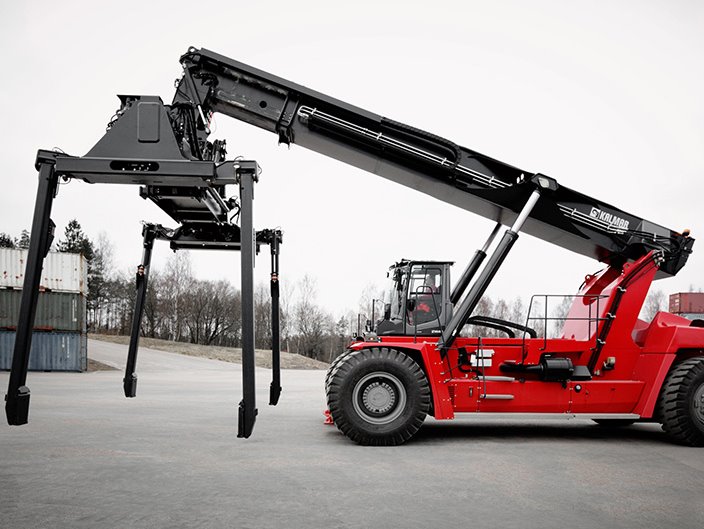
"Kalmar_cranes" by Alphast is licensed under CC BY-NC 2.0.

Model Information
The Kalmar Container Crane is part of the Walthers Cornerstone product line as item #933-3109. The kit is based on a prototype built by Kalmar, found in terminals big and small around the world according to the instruction sheet.
The container crane has finally been built and is operational which was not an easy feat. More on that to follow.
After the debacle with painting the Mi-Jack I opted not to paint this kit hoping it would in fact operate. I did add a painted crane operator though.
The crane came with a bag of small ball bearings to be glued inside the frame prior to attaching it to the body. I was skeptical about  trying to add the whole bag as the instructions showed them only being glued into trough in the frame. Stick on wheel weights solved the not enough weight to hold a container aloft problem.
The Kalmar crane is basically a very large forklift that uses a spreader bar and arms to pick up 20' and larger containers.
The crane offloads a 40' container as a driver with an empty chassis waits to the left.
The driver has backed under the chassis for the operator to place the container which will be driven to the yard for pick up by a road driver or loaded into a different container carrying car.
With the 40' container now out of the way the operator has closed the spreader arms and  moves to lift the 20' container. A driver with a 20' chassis stands by at left to receive the container.
The spreader arms do a good job attaching to the various containers I use on the layout.
The containers can be held aloft as there is enough friction in the sliding parts to hold all but the heaviest of my containers.
The kit comes with decals for various railroads and Kalmar itself. By not painting the kit decals won't be added. No big deal since the road names don't fit the layout and the large Kalmar looks to big for the model.
The Kalmar Container Crane is back at the Terminal Yard Ramp lifting the same container from the chassis shown earlier. Check out the operator in the cab. A nice little detail for an action shot.
The driver pulls away and the container is placed on the 60' COFC car.
The Kalmar Container Crane prepares to lift a Dole refrigerated container from it's chassis out of the way of the Mi-Jack and activity on the ramp which is at right.
The container crane is a versatile machine that can handle lifts anywhere in the yard where it will fit or on the ramp as long as it stays out of the way of the Mi-Jack.
With the spreader bar removed the crane becomes a very large forklift that can assist in the lifting of smaller Caterpillar equipment on and off flatcars.
With the 30 ton crane now at the Empire City Caterpillar their loading dock was moved to this location across from the Terminal Warehouse & Cold Storage Complex and the TOFC / COFC ramp.
Looking towards Terminal Yard we get a nice view of the Mi-Jack working the ramp with the the Caterpillar and other earth moving equipment in the foreground.
Tales from the Ramp
A container crane like this one fit into the tight confines of CSX Hulsey Yard in Atlanta, GA which didn't have the clearances needed for the Mi-Jack. The cranes used in both Hulsey Yard and Fairbairn had the arms for also bottom lifting trailers. The crane had many uses and its portability made it the perfect tool to handle lifts all around the yards.

In Fairbairn, which was a large dedicated intermodal yard / ramp the Mi-Jacks handled  the bulk of the work with cranes like the Kalmar working a single track (#6?) that could only be accessed from only one side.

The procedures used with the Kalmar type crane was pretty simple. A yard tractor with a container on chassis pulled up between the crane and the car it was going into. The crane lifted the container off the chassis and the yard tractor pulled away with the empty container. The crane then loaded the container onto or into the waiting intermodal car. 

The tractor operator would then park the empty chassis and grab the next container on chassis to be loaded into the train be worked. There were usually several tractor operators assigned to a crane operator so this went pretty smoothly. 

Using the Kalmar type crane to load or unload the railcars had an added benefit that kept the ramp clean. The movement of the empty chassis as each was emptied made working with this type of crane  much different than having to clean up trackside after the Mi-Jack went thru.
Final Thoughts and Comments
The Kalmar Container Crane was a pretty straight forward build with the exception of the ball bearing weights and installation of the fork lift retainer pin. The instructions have this step AFTER installing the front axle and wheels which effectively blocked the hope for the pin. I didn't glue the wheels onto the plastic axle and was able to remove to be able to insert the plastic retaining pin which locks into place without glue. 

Extreme care is needed when gluing any of the parts that contain the parts that are meant to slide. Flash on the inside of the sliding parts will need to be cut and filed.

Additional Links & Photos
Kalmar Crane with side arms for bottom lifting a trailer.
CSX Fairbairn Yard today. A short video showing the recent large expansion. 
Thanks for reading!!!
See you soon!!!

Saturday, August 1, 2026

Adding an HO Scale Mi-Jack Intermodal Crane

 Greetings All,
Adding a Mi-Jack Trans-Lift Intermodal Crane
In order to prepare for an expected increase in Intermodal Service a Mi-Jack trans-lift intermodal crane kit was purchased to expedite the loading and unloading of containers and trailers from road freight to railcars.
Background
The late 50's and 60's were a time of innovation and change for intermodal operations but loading and unloading trailers remained a constant headache. Terminal were equipped with huge ramps, some several tracks wide, where trucks backed onto flatcars to drop or retrieve trailers. This was known as "circus loading" as it resembled methods used years before to load circus wagons.

Once the flatcars were spotted there could still be problems such as missing bridge plates, stuck hitches, hitches needing to be powered or raised and more. Another issue was that all the flatcars had to face the same way and time was often lost switching cars. A trailer carrying a "hot load" (such as mail or food) could be several cars deep and had to wait until all of the trailers ahead of it were removed.

To alleviate these problems the New York Central developed the "Flexi-Van" system in which containers swiveled onto special flatcars. Mechanical problems and shortages of wheel/axle bogies along with high maintenance costs and low availability of auxiliary equipment made this system undesirable.
Prototype Information
What's a Mi-Jack Trans-lift Intermodal Crane?
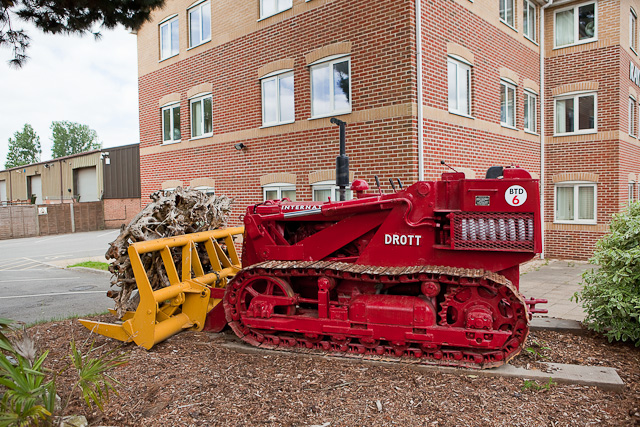
Another solution for the existing intermodal inefficiencies was a self propelled crane developed from a boat lifting design. Drott Manufacturing teamed up Mi-Jack Products to build these early units. 
"Bulldozer outside Raymond Brown head offices" by Peter Facey is licensed under CC BY-SA 2.0.

In the 1960's Jack Lanigan Sr. joined with Drott to spearhead the use of these cranes for railroad duty. The units were tested on the ATSF for containers used by shipping lines but these containers required special equipment to lift them on and off their highway chassis. Some railroads simply handled them as trailers leaving them on the chassis for shipment by rail.
"Santa Fe TOFC (Trailer on Flat Car)" by Gary Lee Todd, Ph.D. is marked with CC0 1.0.

The Drott crane tests caught the attention of the Union Pacific and Southern Pacific railroads. Based on data from the test models Drott Manufacturing and Mi-Jack Products improved the design with a reliable stabilizing beam to eliminate swaying problems.
"20061105 13 BNSF Intermodal Terminal" by davidwilson1949 is licensed under CC BY 2.0.

Unit #1 was delivered to the ATSF in 1963 and assigned to Corwith Yard near Chicago. A second unit was ordered for Hobart Yard near Los Angeles which was delivered in 1965. At this time the ATSF began to develop their container business which required the capability to lift containers from the top or bottom. Mister Lanigan solved this problem by developing a slide latch which used the existing holes on tops of the containers, originally intended for grappling hooks.
"Orient Overseas Container Line On TTX Flatcars Rolling On BNSF Rails In Texas" by T. Hammonds MSW is licensed under CC BY-NC-SA 2.0.

Jack Lanigan Sr. established Mi-Jack Products in 1955 and became a dealership to sell the Drott cranes to the railroads during the 1960s.
"Mi-Jack Boom Crane" by Anntholley is licensed under CC BY-SA 4.0.

J.I. Case acquired Drott Crane in 1970 but decided to drop the line in 1980. At that time Lanigan made the move from dealer to manufacturer purchasing the patents, drawings, parts and inventory from Case and set out to redesign the machines.
"Delaware State Fair - 2012" by Lee Cannon is licensed under CC BY-SA 2.0. 

Eventually these cranes became the Trans-lift Crane a dual purpose machine ideally suited to the modern mix of trailer and containers traveling by rail. Trans-lift Cranes have proven themselves over time with a 99% availability and handling up to 100,000 lifts per crane per year depending on traffic density.
"Yard" by Plonq is licensed under CC BY-NC-SA 2.0.

Model Information
The Walthers Mi-Jack Trans-lift Intermodal Crane is part of their Cornerstone Series sold under item #933-3122. The kit parts come molded in orange, a decal sheet for several railroads with Mi-Jack lettering.
The newly finished Mi-Jack is placed at the TOFC Ramp in Terminal Yard which was the intent when I finally stopped stalling on making the purchase.
The big blue 30 ton crane now displaced returned to its original home in Empire City.
The big crane is now back at its original location lifting Caterpillar equipment for Empire City Caterpillar. A bit of an overkill but I like the crane and want to use it.
The Mi-Jack crane provides the muscle to keep the intermodal traffic moving to meet its tight schedules and ensure profits. The Mi-Jack with the right operator can complete a lift and place cycle in less than one minute. That is very impressive!!
TOFC / COFC traffic is a source of high revenue for the railroad and it's prompt movement from railcar to ground or chassis and back can make or break contracts with the big trucking companies that rely on timely deliveries to their consignees.
TOFC/COFC Videos
Here's a good look at some TOFC highlights on the layout circa 2022

An HO Scale shout out to the Penn Central 1973 Award Winning TOFC Program from July, 2023.
Tales From The Ramp
During 2010 I worked as a CSX Intermodal Worker in both Hulsey Yard in Atlanta which did not have the room in the yard for Mi-Jacks and the Fairbairn, GA dedicated intermodal yard or ramp as it was known from the old RR terminology which did. I was fortunate to work with some really good guys and crane operators. Two who stand out among the cast of characters were Danny, nickname "Alabama" and "Hollywood". 
"Atlanta" by brandonwalker8402 is marked with CC0 1.0.

These guys were amazing with the Mi-Jacks. They could swoop a container right onto the front pins of the chassis without missing one all day. Of course this was against the rules but it saved a lot of time and was mostly overlooked when it suited the company. If the operator missed it could cause damage to the neck of the chassis. When the crew pulled together it was a sight to behold.
"Intermodal" by BlueShift 12 is licensed under CC BY 2.0.

One of my duties was to drive a yard tractor to deliver or remove trailers from the ramp adjacent the railcars. During the unloading cycle the crane operator would call for chassis depending on the containers as the chassis were either part of a pool or owned by a company like JB Hunt. Digging out the right chassis could be an adventure at times.
"20030531 09 BNSF Cicero Intermodal Terminal" by davidwilson1949 is licensed under CC BY 2.0.

The other job I held frequently was the "grounds man" who climbed the cars to unlock the inter box connectors that held the top container in place. Once we cleaned the top I started back in the opposite direction and pulled the IBCs from the bottom container securing them in the holders welded into the railcars. I liked this job as it was good exercise and most people didn't want it.

During this time CSX and UP created UMAX container service.
"2/2 NS 8104 Leads EB Intermodal in KCMO 7-20-19" by KansasScanner is licensed under CC BY 2.0.
Another thing I learned was that the CSX Fairbairn Yard/Ramp did the intermodal lifts for BNSF during my tenure and you could always rely on at least one if not two huge BNSF trains with containers on the head end and trailers on the rear arriving right after lunch time on a Saturday afternoon. Hello, forced overtime... I hated the BNSF!!!
"Intermodal at Fullerton" by ahockley is licensed under CC BY-NC-ND 2.0.
However I did get to see one of the Super Fleet Warbonnets which was very cool.
"BNSF 790 OIY 10-6-12" by THE Holy Hand Grenade! is licensed under CC BY-ND 2.0.

The accolades afforded to the Mi-Jacks in this article are 100% accurate from where I witnessed them in action day after day up close and personal.
Final Thoughts and Comments
For whatever reason this kit ate me up and spat me out. If you've ever tried building a model kit and wanted to throw it against the wall this was that kit. The instructions were hard to follow. I put together as many sub assemblies as possible for painting and adding decals. This exacerbated the build process as parts continually broke off whether attached prior to painting with Bondene or post painting with CA.

The kit is designed to have an adjustable trolley to go side to side and expand to handle 20' and larger containers. Note: All containers 40' and longer have their pick up holes at 40' which is an industry standard. The kit also came with four adjustable grappler arms to lift trailers. Fuhgeddaboudit!! The pins holding them in broke off at the first attempt to do this!!! As the Mi-Jack sits today on the layout it can roll freely but cannot do any of the functions listed in the instructions.
Additional Information
Much of the above information was provided in the Walthers kit and credits Jack Lanigan, Sr. and Trish Vesely of Mi-Jack Products.
Thanks for reading and watching!!!
See you soon!!!