New York Central Alcos

New York Central Alcos
NYC RS32 #2040 leads a trio of R32s hauling Train NY-4

Friday, April 10, 2015

Penn Central U-Boat Make Over

Greetings Blog Followers,

I recently had the opportunity to give one of my three Athearn Blue Box Penn Central U28Cs a make over thanks to fellow modeler and Penn Central fan known here as PC Ralph. Here's the story of the make over and some PC six axle U-Boat tidbits.

PROTOTYPE PENN CENTRAL SIX AXLE U BOATS: Built by General Electric starting in 1963.

U23C  6700-6718 Delivered new to PC in 1970 for hump yard service. U30C body with 12 cylinder FDL engine. Saw occasional road work to clear out accumulated carbon deposits.

U25C  6500-6519 Delivered new to PRR in 1964-65  Featured a one piece windshield.

U28C  6520-6534 Delivered new to PRR in 1966. Featured two piece windshield and new style trucks.

U30C  6535-6539 Delivered new to PRR in 1967. Featured FDL-16 3,000 hp prime mover.

U33C  6540-6563 Delivered new to PC in early 1968. Ordered by PRR. Featured large wings on long hood. Missed being PRR power by only a few weeks.

THE ATHEARN BLUE BOX MODELS: Three U28C models purchased new from Caboose Hobbies in Denver in late 1990s. Order was for one powered unit and two dummy units. Typical Athearn powered product from that time period with metal handrails, sintered wheels, all wheel drive, dual flywheel motor and horn hook couplers. All units in road number 6533.

ON THE LAYOUT: At time of purchase my train layout was much smaller and tighter than today and featured 18" and 15" radius curves. These units were not well suited for that set up and consequently spent much of their first years in the box.

Fast forward to 2002 and a new layout with larger radius curves. The units saw some action and I renumbered two of them from 6533 to 6538 and 6583 with a fine brush and white paint. Were only PC engines in the stable at that time and their usage was light. So light that I discovered that I had never hard wired the unit in all the years I had it when I began this project.

The lone powered U28C in the fleet of three proved to be not powerful enough to pull the two dummies which were like sleds at first and a decent sized train. Often the engines were longer that the rest of the train. After I got the dummies to be free rolling I added one powered and one dummy BB U28C in P.R.R. livery to my son's growing engine fleet. This allowed me(and him) to swap out the power chassis and pull trains worthy of this amount of visual power. So now a three unit consist has two powered units.

Fast forward to 2015 I came across a BB PC U Boat featuring the red "P" logo for sale on ebay. It looked good and I forwarded the ebay link to PC Ralph. After an exchange of e-mails where I told Ralph I was thinking of painting one of my units with the red "P" if I had the decals in stock. Ralph generously offered to provide the red "P" decals for the project. Being even more generous Ralph sent me an envelope of numerous PC logos featuring the red "P", orange "C" and some others from the Micro Scale PC Esoterica decal set. Thank you Ralph!

With the red "P" decals now at hand I selected U28C 6583 to be stripped, painted and lettered as PC 6557 which actually wore the red "P". PC 6557 was a U33C but I didn't let that stop or bother me for this project.

The U Boat has been stripped and painted gloss black and the decals are ready to go

I kept the cab separated for the numbering process. This way I could dull coat it
 and then add the windshield. This way I only had to attach the cab once and 
reduce the chance of scratching it with the metal handrails.   

Decals have been cut and are ready to go. 

Newly lettered PC 6557  

Engineers side of PC 6557

PC 6557 and 6533 go nose to nose

Typical 1990s Athearn BB engine set up. This is my NH SDP40 power chassis

Note the metal sliding bar used for electrical contact

Removing the metal bar and "hard wiring" the unit
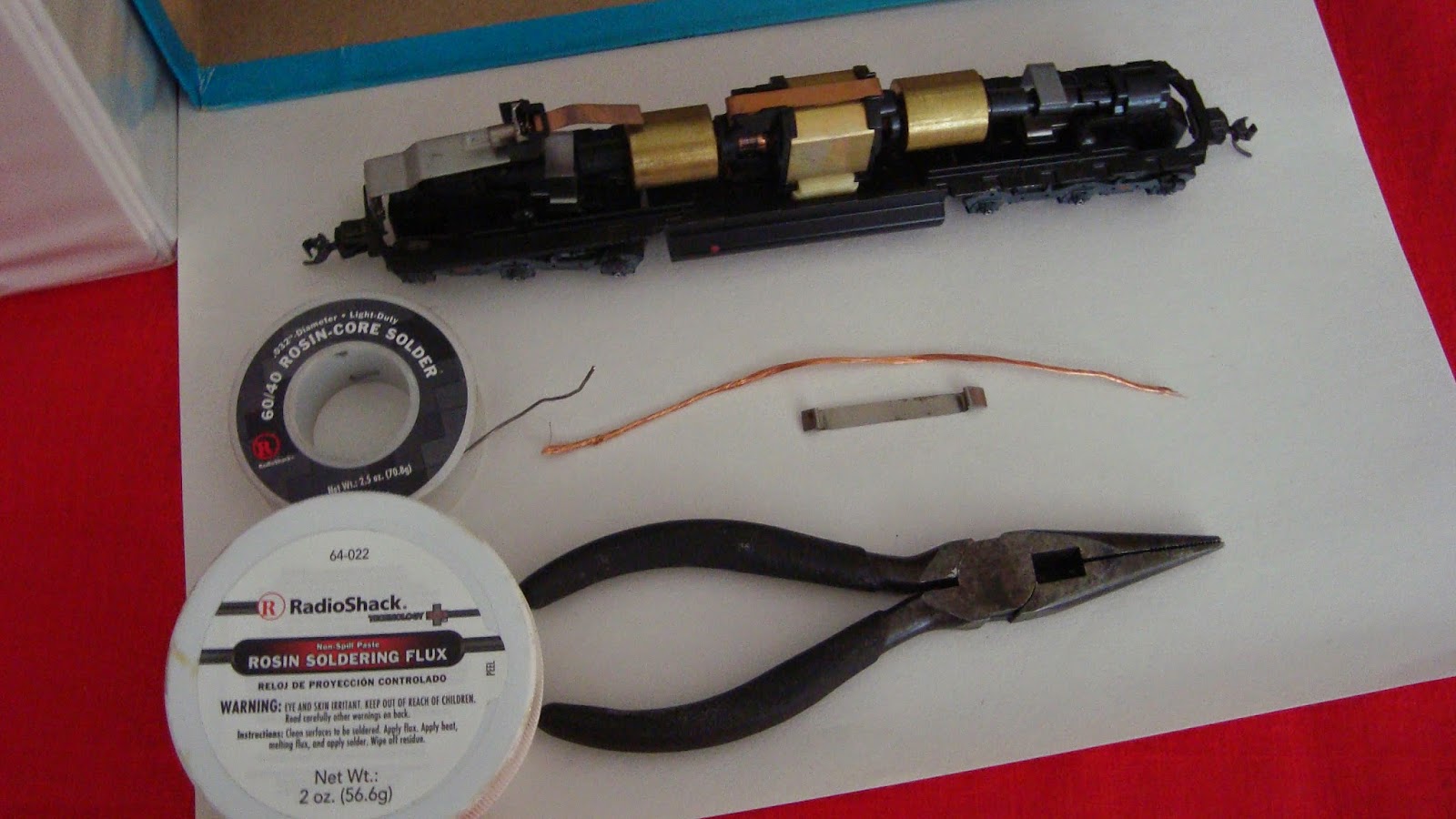
Hard wired and ready to go

PC 6557 with 6538 and a U Boat still in PRR paint lead a train into Empire City Station

The 6557 showcases it's eye catching red "P" courtesy of PC Ralph.
The 6557 was the only six axle U Boat to wear the elusive red "P".  

Three U Boats invade Empire City Station while a coal train crosses the Empire City Viaduct

The U Boats shake the glass of the control tower 

The 6557 gets a passing glance from some EC Station passengers.

Saturday, April 4, 2015

2 Penn Central K-9 Stock Cars Added to the Fleet

Greetings Blog Followers,

Two seemingly unrelated events transpired for me recently and the end result was two Penn Central K-9 Stock Cars being added to the fleet. First while watching Volume 2 Part 1 of the Greenfrog New York Central Odyssey video I noted at or about the 17:40 mark two unique looking 50' stock cars as part of New York Central Train NY-2. The second event was my L.H.S. having a 40% sale on used merchandise. I remembered seeing the Bowser boxes for these cars on a used shelf so I hurried on over and made the purchase.

PROTOTYPE K-9 STOCK CARS: Built by the P.R.R. from 50' X-32 double door automobile boxcars. The P.R.R. cut out ventilation holes in the car body and added new doors. Some interior modifications were made and it appears that there was a class K-9, K-9A and K-9B. The cars had either single or double level decking.  The P.R.R. had about 329 of these cars on the roster into 1968, the year of the merger with the NYC.

MODEL K-9 STOCK CARS: The models are from the Bowser Executive Line and come fully assembled with EZ mate knuckle couplers and metal wheels. Testing the cars I found that the couplers were too low but it was an easy fix. A gray Kadee washer in the coupler box below the coupler eliminated the vertical play and coupler sag. A red Kadee washer placed on the bolster raised the car to the proper height. The car felt a little light to me but it looks to have the shell and frame glued together. Instead of prying the model apart I placed them both on the front of a long freight train and they tracked fine.

NEW YORK CENTRAL TRAINS NY-2 and NY-4: Were daily high priority meat product trains from Chicago to New York City. They often ran in multiple sections with over 100 cars in each section.. The empties back to Chicago were handled by NYC Train LS-1. In 1974 Penn Central NY-2 and NY-4 ran from Blue Island Chicago to Selkirk NY. Train LS-1 from Selkirk NY to Blue Island. This seems to indicate the declining rail traffic and increased trucking of products into NYC.

ON THE LAYOUT: NY-2, NY-4 and LS-1 are a layout staple. Although not to the 100 plus car consist! Adding the two K-9 Stock Cars gives the trains a little more prototypical variety.

Two new K-9 Stock Cars on a test run.

The K-9 lineage of being former X-32 round roof double door boxcars is readily apparent 

The under frame "Bowser made in USA" . 
Note the red Kadee washers on the bolster to raise the car up slightly 

A quartet of PC power is on point today leading NY-2 to Terminal Yard
The engines, GP38s and GP35s  are custom painted Athearn BB models.

The new K9 cars are working fine on the front of a long NY-2 meat products train.
Not sure if the engineer is enjoying the barn yard smell though. 
 The jade green PC reefer car to the right is a custom painted Model Power car.

On the New York Central NY-2, NY-4 and LS-1 were mainly powered by ALCO units and today is no exception. An ALCO FA-FB-FB-FA lash up has the LS-1 well in hand as it heads back towards North Side Yard and ultimately Chicago.  

Saturday, March 28, 2015

Penn Central Covered Hopper # 886759

Greetings Blog Followers,

This past week a new American Car & Foundry 3 Bay Center-Flow Covered Hopper was added to the freight car roster. I did some research on the prototype and before we get to the pictures let's take a quick look at what the car is and what it does.

ACF 3 BAY CENTER FLOW COVERED HOPPER: The car was designed and built in the mid 1960's to carry grain or grain type loads. An extremely popular car that boasts a 4,650 cubic foot capacity and ACF built over 15,000 units. These cars have a Plate C clearance. ACF also introduced a 4,600 cubic foot capacity car that was lower and longer and met the tighter Plate B restrictions.

THE MODEL: The model 3 Bay Center Flow Covered Hopper is an Accurail 2000 series kit. The kit is easy to build and includes everything needed to get the car rolling. Accurail provides dummy knuckle couplers as well as Accumate knuckle couplers and plastic wheels. Accurail has upgraded the kits by adding screws to secure the coupler lids and trucks. This eliminates the former push pin coupler boxes lids that were prone to drooping and adds better truck control.

Accurail Item # 2100 Penn Central 3 Bay Covered Hopper kit Made in the USA 
is built and ready for service. 

Note the screws holding the coupler box lids in place.
The car has been upgraded with Intermountain metal wheels and Kadee #5 Couplers 

A nice idea by Accurail is the renumbering decals for this and other models. By sending in the $4.00 you get a small sheet of numbers for this specific car and paint scheme that can be used to expand your fleet. I have used the numbering decals on some NYC equipment and they worked very well.

It didn't take long as PC 886759 is the lead hopper on this grain train. 

PC 886759 with older brother NYC 892086 on the move through Industry City

3 custom painted Athearn BB Penn Central EMD Engines lead a grain train made up of Accurail kits. 

 CB&Q,  PRR,  NYC,  PC and three growling diesels!  
 

Saturday, March 21, 2015

Penn Central GP40 #3180 Joins The Fleet

Greetings Blog Followers,

Another Penn Central engine has joined my growing PC fleet. GP40 #3180 has just been released from the paint shop and made it's debut on the Empire Division this week. Let's take a look at the prototype and model:

GP40: A locomotive built by Electro Motive Division of General Motors (EMD) in 1965 with the new 645 engine that replaced the 567 engine. Equipped with an a.c. rectifier transmission the new GP40 won it's initial order from the New York Central and who subsequently ordered a total of 105 GP40s. The Penn Central ordered 175 GP40s from EMD through 1968 and 1969. The GP40 was produced from 1965 through 1971. The GP40-2 was produced from 1971 through 1985. All told EMD produced over 1,200 GP40s and over 1,100 GP40-2s.  The GP40s were not that different from the GP38, which was another Penn Central favorite, except that they included some newer technologies; an extra radiator fan, a turbocharger stack and an extra 1,000 horsepower (rated at 3,000 hp vs the 2,000 hp of the GP38 series)

Penn Central GP40s: Penn Central rostered a total of 280 GP40s. 105 from the NYC and 175 the PC received in 1968 and 1969. PC GP40s were numbered from 3000 to 3274. The former NYC units were numbered 3000 to 3104. 3105 to 3274 were the newer PC ordered GP40s. Of these numbers 3170 to 3186 received the rare white "P" and orange "C" PC logos. Ex NYC GP40, PC 3001 sported the more common but still rare red "P" and white "C" logo.

The model PC GP40 #3180: The model is a Bachmann blue box straight DC unit that I purchased second hand. The model has been stripped of it's prior road name paint job and painted with rattle can black. The decals are from Microscale.

Penn Central GP40 #3180 sports the rare white "P" and orange "C" paint scheme as it rolls towards Terminal Yard between two GP38s 

PC GP40 3180 in the rocking chair of the three unit consist

Close of the 3180 shows that it is missing it's horn so it's been tucked between the GP38s.
The 3180 is a custom painted Bachmann straight DC model

 PC GP38 7692 is a custom painted Athearn BB model

PC GP38 #8024 is also a custom painted Athearn BB model

The 3180 has been separated from it's GP38 brothers and sits on track 9 at Terminal Yard. The Yardmaster shows his class by coupling the 3175 with the 3180 to give the Empire Division rail fans a treat.
The 3175 is a custom painted Athearn model

Workers scurry about the 3180 as they get ready to replace the missing horn. Looks like 1/87th scale Sir Neal (blue coveralls, white shirt) has dropped by to see the newest engine in the division.
PC SD40 6282 is a custom painted Athearn BB model

A shot of the 9 track Terminal Yard. With the exception of the U-Boats on track 8 all engines were custom painted by yours truly.

Track 9 is usually the engine track and it's no exception today. 

Six axle PC Power on track 2. Both are factory painted models. 
The SD35 from Atlas and teh U-Boat from Athearn

A view from the yard lead. Penn Central GP30s on track 6 are custom painted Bachmann Spectrum units. 
The NYC H16-44s on track 4 are also custom painted Spectrum units.
The PC RS2 on track 3 is a custom painted P-1000 unit.  

A view from above. I added the buildings to the scene to obscure some of the train boxes.

Looks like the 3180 is ready to roll as it has received it's new horn.  

Time to roll out!

Thursday, March 12, 2015

FA-FB-FB-FA Project Part 3

Greeting Blog Followers,

I have to admit I'm excited about this project and the way the engines have turned out. After studying available New York Central Cigar Band FA and FB pictures upon pictures I opted for the early 1960s or original cigar band FA and FB scheme. Trust me this was not an easy decision as I went back and forth several times right up until I started cutting out the decals.

So what's the difference? The early cigar band had the NEW YORK CENTRAL about mid flank with small numbers below while the later version had a larger NEW YORK CENTRAL just above the sill with large numbers towards the rear.

My new FA-FB-FB-FA units are now numbered 1012-2305-2306-1020. These are correct NYC FA1-FB1 numbers. The project required two sets of Microscale 87-88 decals to get the proper NEW YORK CENTRAL lettering and numbers.

Let's check out the pictures...

The ALCO FA-FB-FB-FA lash up has been painted gloss black. For those spray can Picasso's out there save the rattle can caps as they make excellent painting stands

The FA-FB-FB-FA Lash Up in flat black. Notice how the gloss black really gives the units a blacker black appearance. I have gloss coated the flat black and lettered some diesels in the past but find it much better to paint the units gloss black and then letter them.

A close up and the decals used for this project, Microscale 87-88 New York Central Diesels 1960-1968.

Newly released from the New York Central Train Layout Paint Shop the ALCO FA-FB-FB-FA units head towards Terminal Yard for final inspection and hopefully their first assignment.

The units have left Terminal Yard and are running light towards Empire City's North Side Yard.
The hand rails are from a Walther's F Unit Diesel Dress Up kit.
The original plastic ones could not be salvaged  

The closely coupled ALCOs hit the curve leading to North Side Yard.
The original mars light has been removed and the bottom hole filled. 

The FA-FB-FB-FA units are on their maiden revenue service voyage with a transfer freight from North Side Yard and are heading back to Terminal Yard with a freight train made up of cars on their way to the Atlantic Pacific Rail Road and the Kings Port & Western Rail Road.   

The newly painted ALCO'S rumble through Industry City 

The following day the FA-FB-FB-FA lash up is on the point of a train from 
Terminal Yard to North Side Yard  

The four unit lash up has plenty of power to handle this steel and auto parts train.
Note the KP&W clam shell rebuilds from Kings Port Steel and further back the coil covered loads from A.P.R.R. on line customer Shapeless Steel   

Friday, March 6, 2015

FA-FB-FB-FA Project Part 2

Greetings Blog Followers,

The FA-FB-FB-FA Project has finally hit phase 2. After receiving some sunshine and temperatures above 50 degrees so I could open the outdoor painting studio called the patio the sounds of rattle can spray paint could finally be heard. Truck side frames, coupler boxes and engine shells each received a coat of flat black. After letting the paint dry I was able to reassemble the truck side frames and install the new knuckle couplers in the newly painted coupler boxes.

A couple of issues popped up with engine shells. The first was that the diaphragms were yellow plastic and did not take the rattle can flat black too well leaving some visible yellow in and around the diaphragms.  I fixed this by brush painting the diaphragms with flat black acrylic paint. After that dried I dropped the shells onto the chassis' and tried to couple the units together in A-B-B-A fashion. A second issue them came to light. The Kadee #5s that were to be used for the project were too short to span the distance between the units as the diaphragms took up the space and would not allow the #5s to couple to each other. To remedy this I remembered and old trick my buddy Neal M of the Atlantic Pacific Rail Road shared with me. Use one long and one short coupler to increase distance slightly so the space between units does not look unrealistic but will allow the units to couple and operate reliably. (we did this with full length passenger cars that had similar diaphragm and some radius issues)

There is a way to do this so that only 3 engines need a swap of a long coupler, Kadee #36 or 26, for the #5. Looking right to left at the FA-FB-FB-FA consist the rear coupler on the A unit received a #36. The rear coupler on the B unit coupled to the A unit to the right received a #36 and the B unit coupled to the B unit to the right received a #36 for the front coupler where it couples to the A unit which retains it's #5 coupler. By doing it this way the units can now run in A-B-B-A, A-B-A, A-B-B or A-A fashion while retaining a nice looking close coupled appearance.

The FA-FB-FB-FA lash up reminding rail fans of the ALCO Black Marias
 lead a freight train out of North Side Yard. 

The units stop on the Empire City Viaduct

A publicity shot on the E.C.viaduct

After initial testing the next stop is the paint shop for final painting and lettering.