New York Central Alcos

New York Central Alcos
NYC RS32 #2040 leads a trio of R32s hauling Train NY-4

Wednesday, September 19, 2012

D.I.Y. Painted Locomotives

Greetings Blog Followers,
As you can see by the name of this blog I model the late great New York Central System. The NYC as it was also known was a class 1 railroad that served the most populous and industrial areas of the United States. The NYC lasted until February 1, 1968 when the mighty NYC combined forces with another decaying Northeastern railroad and it's primary rival the Pennsylvania Railroad, formerly billed as the Standard Railroad of the world to become the Penn Central Transportation Company, or the PC. This is the period that I enjoy modeling. Finding diesel locomotives painted for this time period is not an impossible task and can be quite easy if one is willing to spend the money. Being frugal I began painting my own locomotives about two years ago. As of this writing I have now painted a total of 18 locomotives, 12 for the New York Central and six for the Penn Central. This does not include re-numberings or adding a decal or two to a factory paint scheme. Here is a sample of the do it yourself painted fleet...

 A Penn Central EMD lash up consisting of an SD40, A GP40 and two GP35s. All four are Athearn Blue Box models. Each unit was an actual locomotive owned by the Penn Central.

 Penn Central SD40 #6282

 Penn Central GP40 # 3175. PC GP40s 3170-3186 received this special paint scheme with the orange "C"

Penn Central GP35 #2252 received the red "P" that was also a special paint scheme and much more widely used than the orange "C". The red "P" was on many different types of units.

 Penn Central GP35 #2327 in the standard large white PC scheme which was also known as the "mating worms logo"

 New York Central GE B23-7 #3893 coupled to sister locomotive #3683. Both locomotives are Bachmann Plus models

 New York Central B23-7 #3683. The NYC did not have any B23-7s on their roster

 NYC EMD GP35 # 2937 coupled to NYC EMD GP40 2933. Both locomotives are Athearn Blue Box models

 NYC GP40 # 2933

NYC EMD GP9s #505 coupled to sister GP9 #412 and SD24 #9844. The GP9s are Athearn Blue Box models and the SD24 is an older Atlas model 

 NYC GP9 #412 and #505 sport the short lived scripted herald logo. 

 NYC SD24 # 9844 has the scripted heralds on the cab sides and the traditional nose logos on the front and rear.

  NYC Fairbanks-Morse H-16-44 #7698 is a Spectrum model 

 NYC Fairbanks-Morse #7340 is also a Spectrum model

 NYC EMD GP30 # 2728 is a Spectrum model

  NYC EMD GP30 # 2526 is a Spectrum model

  NYC EMD GP30 # 2324 is a Spectrum model


Saturday, September 15, 2012

Can You Say...R.E.A. ?

Greetings Blog Followers,
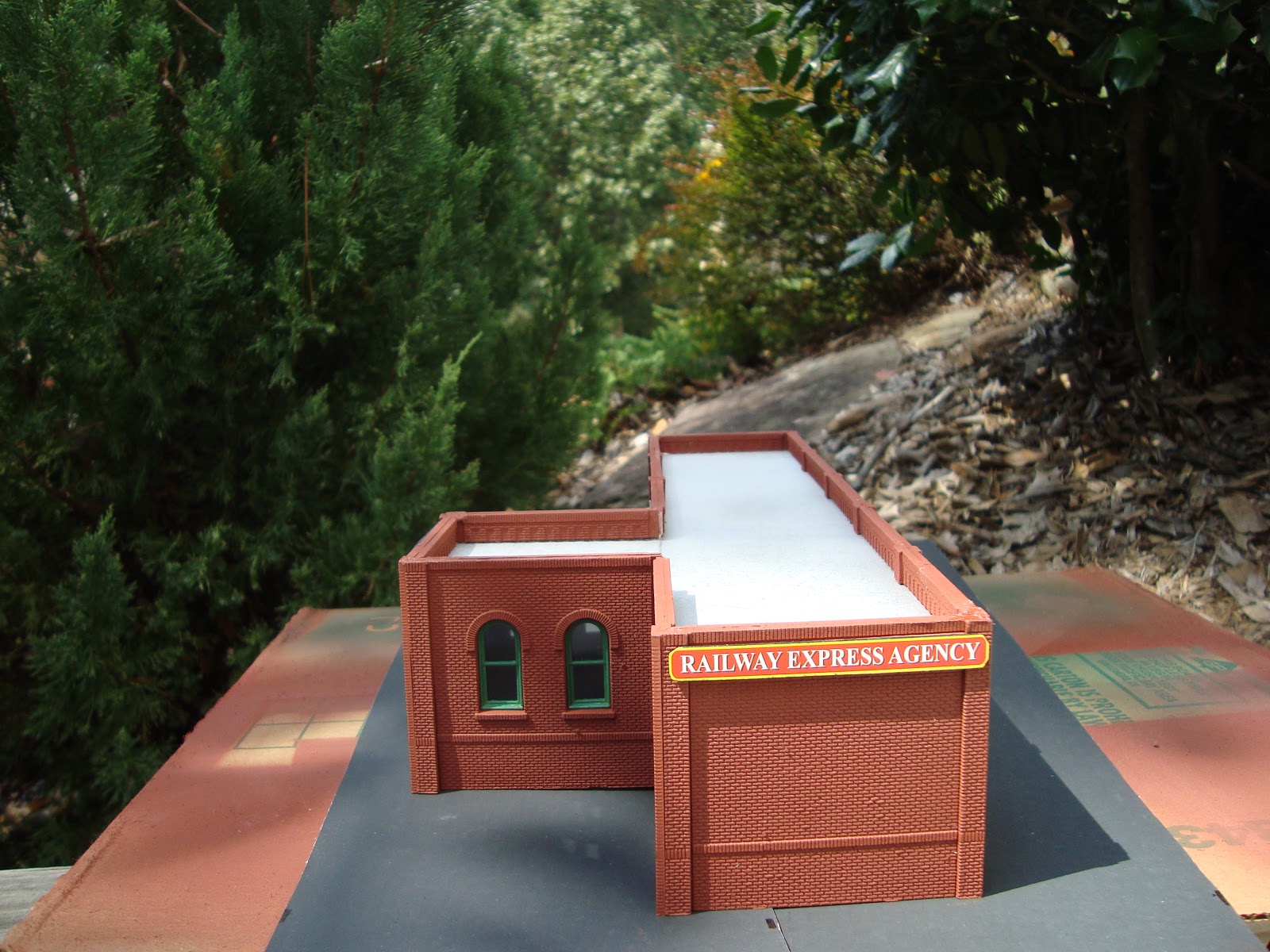
The newest addition to the layout is a Railway Express Agency Building. The Railway Express Agency, also known as the R.E.A., was a monopoly set up by the the United States government in 1917. Concerned about the safe rapid transportation of parcels, currency and goods during World War I, the Railway Express Agency provided a solution to those problems. After tough times and dwindling freight in the 1960s the Railway Express Agency was sold off in 1969 to five of it's corporate officers who formed the REA Express. The R.E.A. ceased business operations in 1975 after the building of the Interstate Highway System allowed United Parcel Service trucks to offer a better rate to the shipping customers.

The R.E.A. concentrated on express refrigerator shipments from the 1940s on. Freight traffic continued to be profitable into the late 1950s but refrigerator traffic started to diminish rapidly as refrigerated motor trucks became more prevalent. Much of the R.E.A. refrigerator fleet was stripped of it's refrigerator equipment and were in lease service as bulk mail carriers. Many ended their lives in work train service.

Interestingly the R.E.A. formed the Air Express Division in 1927. This lasted until 1959 when the Civil Aeronautics Board terminated the R.E.A.s exclusive shipping agreement for air express shipments. Another interesting tidbit is that the R.E.A.also tried to enter piggyback and container operations without success. Today R.E.A. predecessor U.P.S. ships many of it's long distance shipments as T.O.F.C. (Trailer on Flatcar).    

The R.E.A. building started out as some D.P.M. modular brick wall pieces.
 The building after it's second painting with decals and windows added


 The building has been given train and truck loading docks and some details
 A side shot of employee vehicles, trucks and the shipping foreman on the dock

A late running R.E.A. employee being questioned by the police

 A view of the truck loading docks

 An Aerial View
 Looking towards the passenger station
 Showing both the train and truck loading docks
 The layout corned is now occupied
 The R.E.A. Building is now in service.


Wednesday, September 5, 2012

Empire City Beautification Part II

Greeting s Blog Followers... Back on May 09, 2012 I posted Empire City Beautification part 1. I am now pleased to report that the beautification project for the station parking lot is just about complete. Check out the before and after photos;
  Before and After

 Before and After


 Before and After


 Before and After


 Before and After


Before and After


 Before and After


 Before and After
 

Wednesday, August 22, 2012

Empire State Express Pulled From Service Again

Greetings Blog Followers.  The New York Central Empire State Express has been pulled from service again. Followers may remember previous issues with the 8 car train that was described in a prior blog post
Sunday, November 13, 2011 Trials & Tribulations of the Empire State Express.The Corrugated Side Cars were manufactured by International Hobby Corp, are a scale 86' and have 4 wheel trucks.They have been on the roster for several years. This past year however has seen the cars pulled from service twice, this time for unscheduled uncoupling issues. The cars utilize after market McHenry talgo mount couplers that were designed specifically for this type of car. The NYC maintenance crews had the cars in their shops for several days on the prior issues and it was believed the problems had been resolved. The cars ran fine when put back into service and were subsequently cycled off the layout for about sixty days. The cars were stored in their original boxes and when reintroduced to the layout this past week they began to have coupling issues right off the bat.
The cars were removed from service for the shop crews to remove the McHnery talgo mounted couplers and install Kadee #5 body mounted couplers for more reliable coupling. The layout's 22" radius curves however proved to be too tight for this application. The cars stayed reliably coupled but were now prone to derailments on the 22" curves. After consultation with other model railroaders and owners of these types of cars one of the #5 couplers was removed from each car and replaced with a long center set coupler. This would provide more couple swing to hopefully get around the curves. This too proved to be unsatisfactory. Additional time was spent cutting off the corners of the coupler boxes to increase coupler swing. Unfortunately after several trips various cars began to derail again.
The shop forces have decided to re-install the McHenry talgo mount couplers and once again fine tune them to meet the Kadee coupler height gauge. To the shop I go......

An A-B-A lash up of Fairbanks-Morse "Erie Builts" lead the Empire State Express toward Empire City 

The Empire State Express on the lower track while a coal drag waits for clearance

Seven of Eight cars of the E.S.E. are visible as the train progresses to the lower level
 
 The E.S.E. heads toward Empire City Station

Rounding the final curve before Empire City Station

The Empire State Express arrives on track 3. On track 2 is the Commodore Vanderbilt and on track 1 is the Mercury

For today's passenger power we have an A-A consist of Alco PAs assigned to the Mercury, a single EMD E8A assigned to the Commodore Vanderbilt and the A-B-A consist of FM "Erie Builts" on the ill fated Empire State Express
  

Saturday, August 18, 2012

Pacemaker Freight and Early Bird Service

The New York Central System introduced it's "Pacemaker" freight trains in 1946. Named after the Central's high-speed New York to Chicago "Pacemaker" passenger train the service was skillfully marketed and aimed at recapturing L.C.L. (Less than Carl Load) traffic. The "Pacemaker" trains featured distinctive specially designed boxcars painted in a flashy vermillion and gray livery with "Pacemaker" written on the sides in script. The cars were equipped with high speed trucks that used stabilizers and bolsters to reduce incidents of in-transit damage. As "Pacemaker" service expanded the box car fleet grew to 1,000 cars.

The "Pacemaker" fast freights originally operated on an 11 hour schedule from Manhattan to Buffalo / Niagra Falls. Carrying the symbol NB-1 the "Pacemaker" left Manhattan at 7:45 PM and arrived at Buffalo 6:50 AM the following morning.  By 1950 "Pacemaker Service" reached most Mid-Western cities within the Central's service region.

In 1954 the New York Central introduced the "Early Bird" trains aimed at recapturing carload traffic through improved scheduling. New York to Chicago service was promised in just 29 hours, "on time a day earlier" than previous trains. A cartoon bird dressed in an engineer's cap and carrying a pocket watch was featured on the sides of some of the "Early Bird" freight cars.

On my train layout Empre City has been included in the expanded "Pacemaker" freight service and the "Early Bird" service. The New York Central's Terminal Yard train master often combines both the "Pacemaker" and "Early Bird" freights into one hotshot train when possible and gets them across this division with time to spare. Take a look as this train runs across the upper level of my layout through Empire City. Also beware of the Sharks that have come swimming into the city.


Sunday, August 12, 2012

Going Big

This month I came upon some Athearn 85' Trailer Flat Cars and some Athearn 86' Auto Parts Boxcars at prices that I could not refuse. The prototype cars were introduced in the mid 1960s and they are right on for my targeted modeling range. These are the first Athearn Blue Box freight cars that I have purchased with a length greater than 57 scale feet. Most of the past reviews I have read on the 85' flat cars and 86' boxcars were not positive as they were reported to be prone to derailments even on very broad curves in excess of 24" radius. Well the price was right and with some tinkering I thought I could get these cars to be reliable runners and then added to the fleet. Here is how I made that happen.
 85' Trailer Flatcar
#1. Clean the rust of of the metal weight and wash the plastic parts with soap and water. Allow to air dry.
#2. Spray paint metal weight, underframe, body bolster and draw bars flat black.
#3. Straighten metal weight as best as possible. 
#4. Attach metal weight o flatcar with adhesive. I used thin double sided tape.
#5. Attach under frame to metal weight with adhesive. Again I used thin double sided tape. 
#6. Add Kadee #27 couplers to the draw bars.
#7. File down hooks on draw bars where they meet the trucks. The draw bars are designed to swivel and make contact with the trucks when installed straight out of the box. Not doing this eliminates the free play the trucks need to swivel freely on their own. 
#8. Attach body bolsters. After building five cars I noticed that quite a few body bolsters needed some filing to fit over the molded on body bolsters. 
#9. Optional I added 33" Intermountain metal wheels to the trucks. This gives the cars a bit more weight.
#10. Attach trucks with 2-56 x 1/4" screws (provided in kit). Again after five cars I noted that on a few I had to use screws from my parts inventory for better truck control. 
#11 Test with Kadee height gauge. Adjust as necessary.
#12. Road Test.

86' Auto Parts Boxcar        
#1. Clean the rust of of the metal weight and wash the plastic parts with soap and water. Allow to air dry.
#2. Spray paint metal weight, underframe, body bolster and draw bars flat black.
#3. Straighten metal weight as best as possible.
#4. Attach metal weight to floor with adhesive and the two short screws provided in the kit.
#5. Add Kadee #27 couplers to the draw bars.
#6. File down hooks on draw bars where they meet the trucks. The draw bars are designed to swivel and make contact with the trucks when installed straight out of the box. Not doing this eliminates the free play the trucks need to swivel freely on their own.
#7. Optional I added 33" Intermountain metal wheels to the trucks. This gives the cars a bit more weight.
#8. Attach trucks with 2-56 x 1/4" screws (provided in kit). Again after five cars I noted that on a few I had to use screws from my parts inventory for better truck control. 
#9 Test with Kadee height gauge. Adjust as necessary.
#10. Road Test.

Here are some of the finished cars


So far the cars are running reliably on 22" radius curves, which are the sharpest on my layout. The above consist also negotiated the #4 turnouts in my staging yard with no problem.